How to Choose a LinkedIn Lead Generation Agency for B2B SaaS
A practical buyer scorecard for targeting, content, conversations, handoff, evidence, reporting and honest answers about accounts and restrictions.

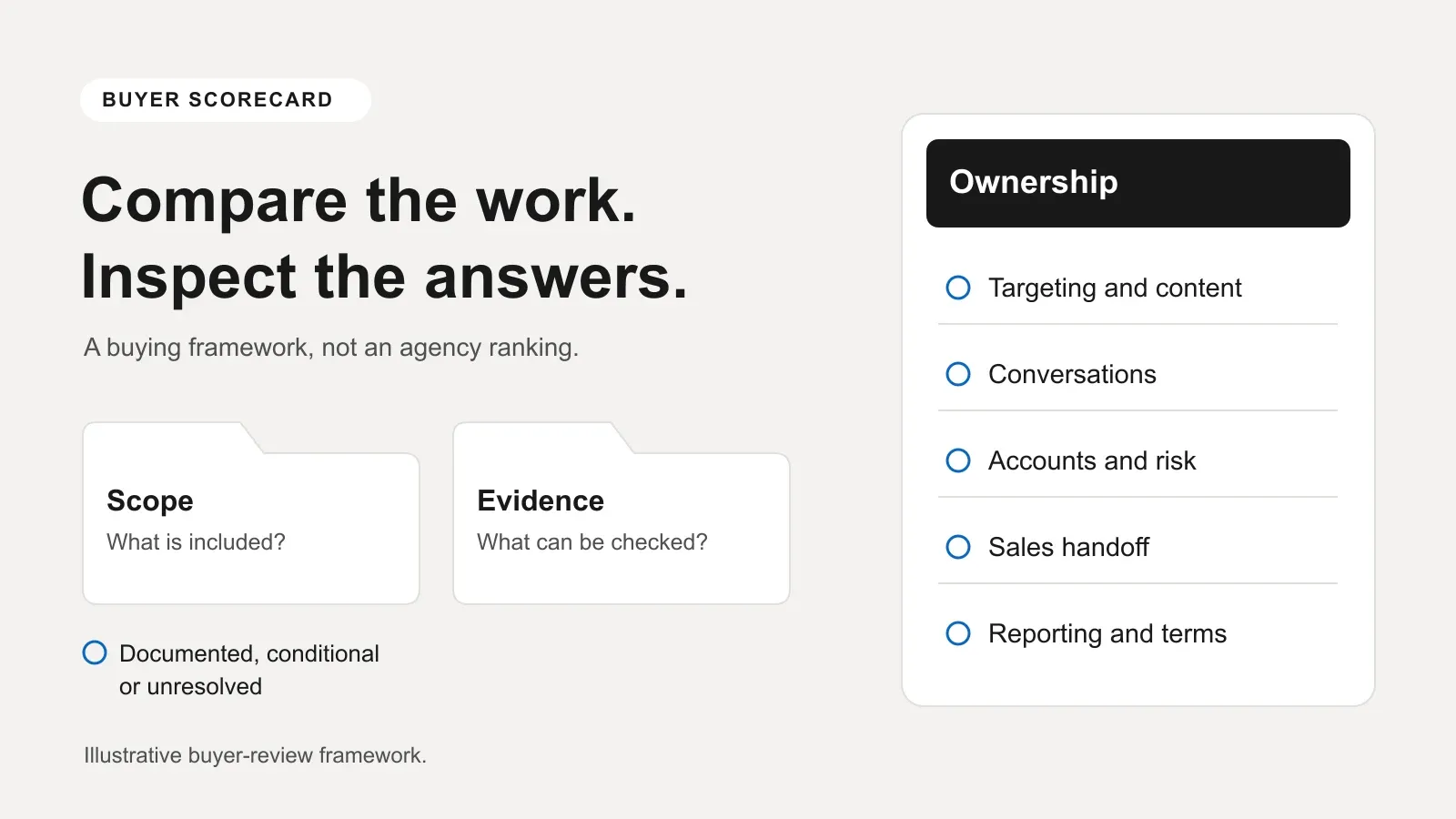
Choose a LinkedIn lead generation agency for B2B SaaS by evaluating the work you are actually buying: a defined audience, credible content and outreach, useful conversations, a clear sales handoff and evidence you can inspect. Put account use and platform-risk transparency ahead of a polished meeting headline.
We recommend using the same questions for every candidate, including us. The scorecard below is our editorial framework, not a validated predictor of agency performance. Its purpose is to expose unresolved decisions before they become operating problems.
Start with a brief, not an agency rankingLink to this section
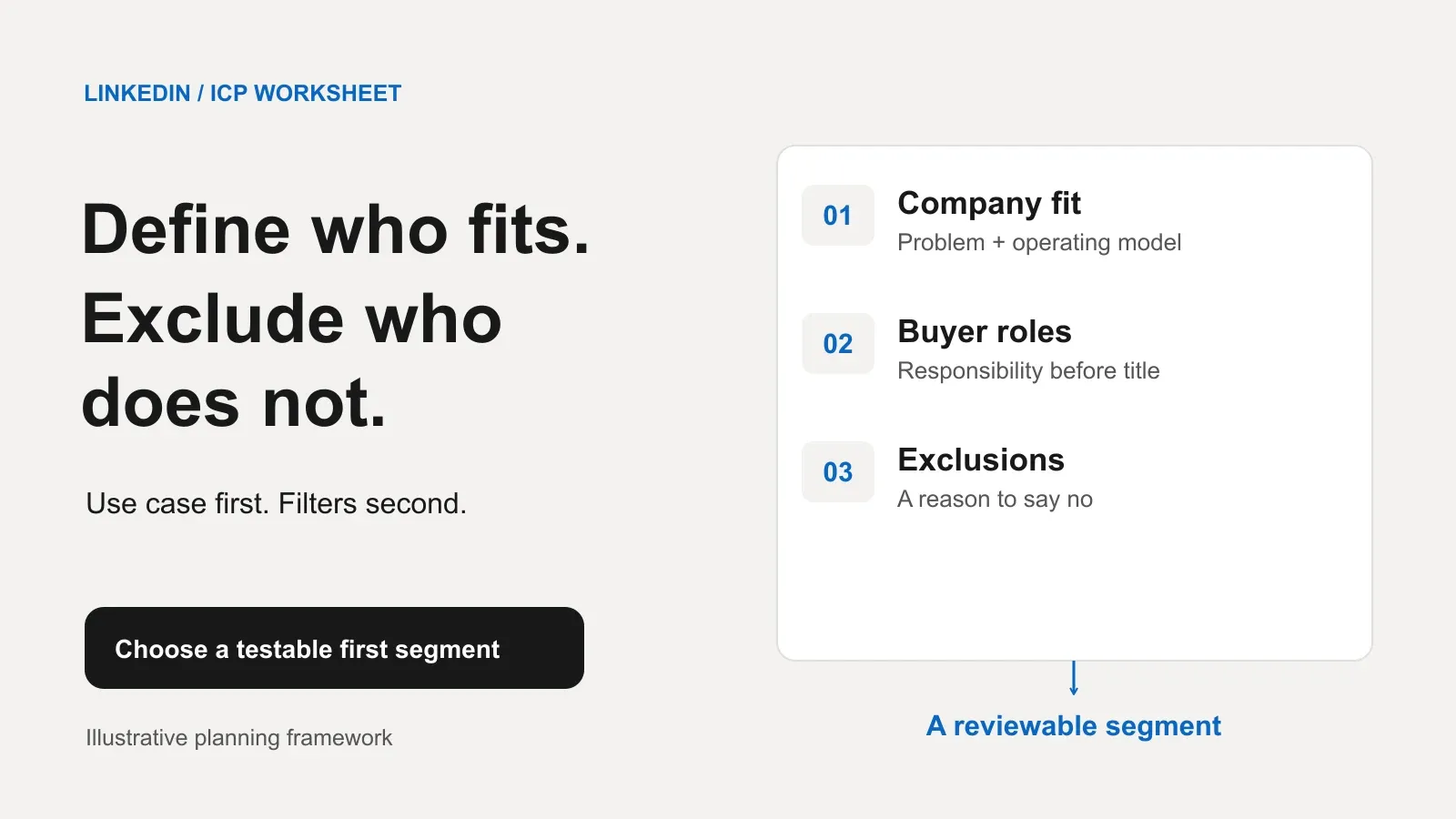
Write a short buying brief before you meet providers. Define the product use case, the companies you want to reach, the relevant buying roles and the exclusions. Explain what evidence your SaaS can honestly use and who will take sales meetings.
Then describe the missing capability. Are you buying prospect research, writing, content publishing, conversation management, qualification or booking? If you need several, say so. An agency that concentrates on one part may still fit, provided the uncovered work has an owner.
Public service descriptions illustrate why scope matters. Cleverly describes targeted prospect lists and LinkedIn messaging.[4] Belkins describes an appointment-setting process spanning research, messaging, qualification and outreach across email, phone and LinkedIn.[5] These are provider descriptions for this October 9, 2026 editorial review, not independent proof of delivery or recommendations.
Do not compare broad labels as though they were identical packages. Ask each provider to mark your requested work as included, excluded or dependent on client input. Make content creation and reply management explicit rather than inferring them from the phrase lead generation.
Use a scorecard based on evidence qualityLink to this section
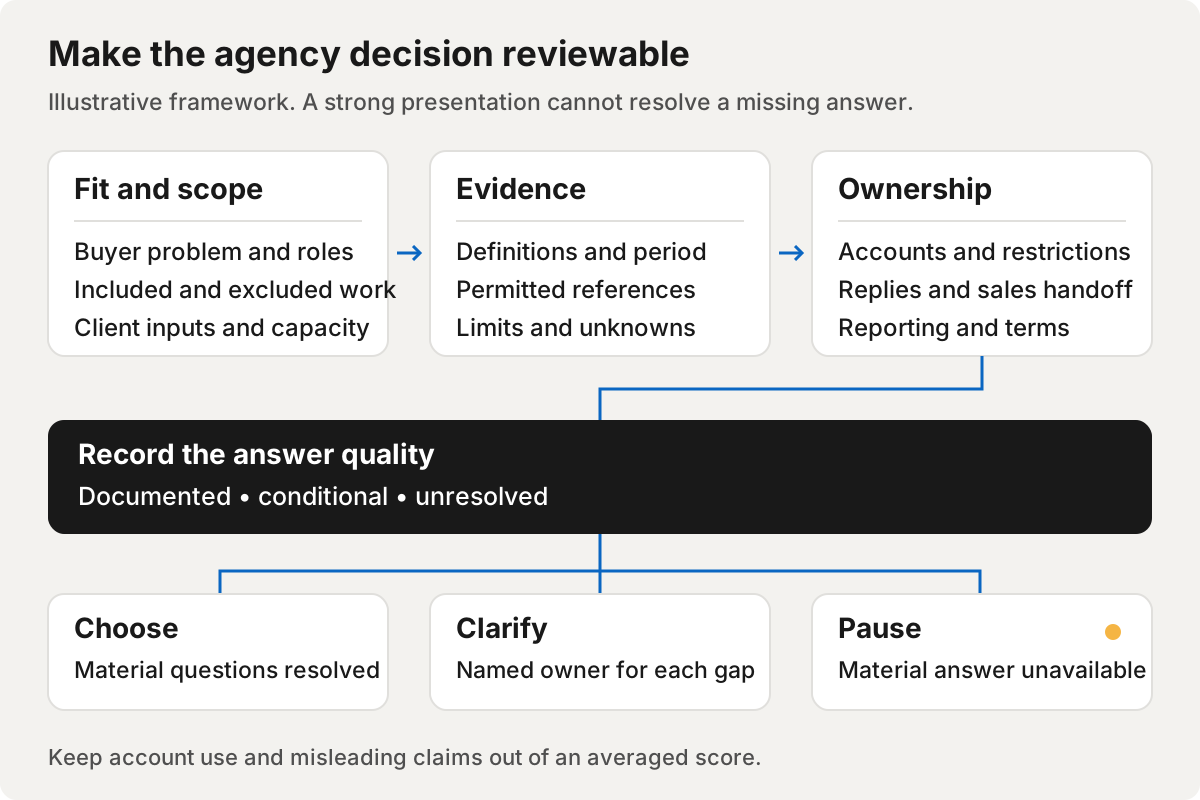
Use these labels without forcing a numerical total:
- Documented: a specific answer, supporting material and a responsible owner are available.
- Conditional: the answer depends on a named input or decision, with a next step.
- Unresolved: the explanation is missing, contradictory or too vague to evaluate.
An honest conditional answer can be stronger than a confident promise. Confidential information can be redacted. What matters is whether the remaining material lets you understand the process and its boundaries.
The table is a buyer worksheet. Its questions and red flags are recommendations, not claims about any particular agency.
| Area | What to ask | How to read the answer | Red flag to investigate |
|---|---|---|---|
| Ideal customer profile (ICP) | How will you select accounts, buying roles and exclusions? | Look for a product use case, a reviewable selection rationale and a process for rejecting poor fits. | Targeting stops at a broad industry label. |
| Content and proof | What will you write, and which claims need our evidence? | Ask for an annotated example and a factual-review owner. Separate content from outreach copy. | Invented proof or generic posts presented as product understanding. |
| Outreach and replies | Who sends messages, answers questions and stops contact? | Expect a workflow, escalation rules and exclusions, not just a sequence. | Replies are counted but nobody owns the conversation. |
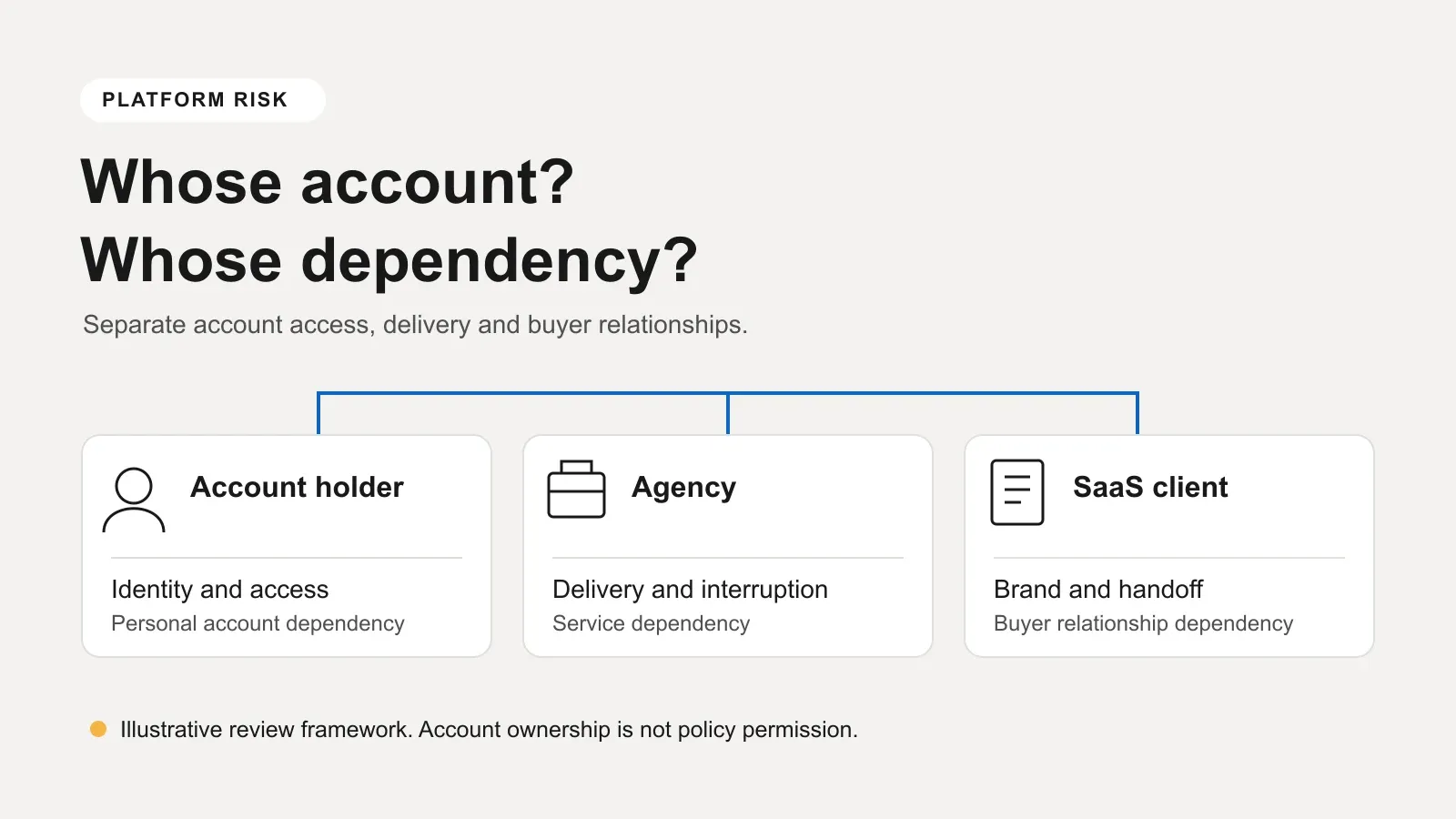
| Accounts and platform risk | Whose accounts are used, how are they operated, and what happens if restricted? | Require direct answers about people, access, tools and interruption responsibilities. | Account ownership is concealed or restrictions are dismissed. |
| Qualification and handoff | What makes a meeting worth our sales team’s time? | Define fit, expressed interest, required context and who accepts the handoff. | Booked and qualified are treated as the same event. |
| Evidence | What can we independently check about a relevant engagement? | Seek definitions, period, channel, client effort and a permitted reference route. | A headline result cannot be traced to its context. |
| Reporting and learning | What will we see, and how will decisions change? | Require stage definitions, exclusions, reasons for rejection and an owner for action. | Activity totals are the entire report. |
| Commercial scope and exit | What are our obligations if work pauses or the relationship ends? | Compare the proposal, order and terms; send unclear provisions for qualified review. | Important exclusions appear only after the sales discussion. |
Choose your non-negotiable areas before comparing candidates. For this framework, we recommend treating unresolved account use, misleading claims or an absent handoff owner as reasons to pause, regardless of strengths elsewhere. Do not average away a material concern.
Ask the account question in fullLink to this section
Ask every agency: Whose LinkedIn accounts will be used, who will operate them, and what happens to our work if an account is restricted?
The first part identifies the exposed sender. The second reveals the access and activity arrangement. The last tests whether the provider has thought beyond launching a campaign.
LinkedIn’s User Agreement prohibits personal-account sharing and using another person’s account.[1] Its prohibited-tools page rejects third-party automation on the website and warns of restriction or closure.[2] Client permission and agency ownership should not be treated as blanket exceptions.
Ask for a written description of the workflow and tools, not credentials or technical instructions for avoiding enforcement. If the agency uses its own accounts, identify the account holders and the client-facing dependencies. If it proposes using your people’s accounts, involve those people in the review. Neither answer alone resolves the platform questions.
Request a restriction plan that covers notification, paused work, scheduled meetings, relevant permitted records and commercial consequences. A vague promise to keep activity running is not a substitute for explaining what stops and who takes responsibility for the remaining commitments.
Test ICP work with an illustrative briefLink to this section
Bring a fictional product use case to the conversation if you cannot share sensitive plans. For example: an invented SaaS product helps operations teams reconcile subscription entitlements. Ask the agency to explain which companies might have that problem, who feels it and what would exclude a prospect.
This is an illustrative exercise, not a real company or observed result. Do not demand a finished strategy before hiring. Ask for the reasoning that would guide the work: how the agency would test the segment, review candidates with you and distinguish a relevant person from an attractive job title.
A useful answer might need your customer interviews or product specialist. Record that dependency. If your own positioning is unresolved, the decision may be to do discovery first rather than pay someone to distribute an uncertain message.
Ask who can change targeting after sales feedback and how rejected meetings inform the next review. A process that cannot incorporate a clearly explained mismatch needs clarification, even if the initial list looks plausible.
Inspect writing and conversation judgmentLink to this section
Ask for a redacted example or a clearly labelled fictional exercise. Have the agency explain why the message is relevant, what evidence supports its claim and what response would cause it to stop rather than send another pitch.
Review content separately. A post may need product accuracy, a clear commercial relationship and a reviewer with enough knowledge to challenge it. LinkedIn’s Community Policies address misleading information, authentic identity, benefit-related disclosure and unwanted promotional content.[3] Treat these as review subjects, not merely tone preferences.
Ask how technical questions, pricing questions, objections and requests not to be contacted reach the right person. Decide what the agency can answer and what requires your sales or product team. A polished initial message tells you little about handling the conversation that follows.
We recommend judging the agency’s ability to explain a choice, not whether its writing resembles your favourite viral post. Clear reasoning is something you can review and correct together.
Define the meeting before evaluating the promiseLink to this section
Write your own qualification definition with the agency. Include company fit, role relevance, expressed interest and the context required for a sales conversation. Distinguish a scheduled meeting from a held meeting and from an opportunity your sales team accepts.
For an illustrative handoff, require the product problem discussed, the participant’s role, the reason they agreed to meet and any unanswered questions. Do not ask the agency to fill those fields with guesses. Unknown context should remain unknown.
Clarify who handles rescheduling, no-shows, duplicates and meetings that miss your written criteria. Decide who records the sales team’s assessment and what happens when the agency and salesperson disagree. These are proposed operating definitions, not universal industry standards.
Also be honest about your own capacity. If nobody can take calls or follow up, booking is not the missing capability to outsource yet. A fair evaluation includes the client work required to make the scope usable.
Read evidence without treating it as a forecastLink to this section
Ask for an engagement relevant to your buying context, not simply the biggest result. Check the buyer segment, channel, period, definition of a meeting, qualification method and client effort. Ask whether the example was selected because it was unusually successful.
For independently checkable evidence, request permission to speak to the client through a verifiable business contact route. Cross-check the agency’s role and the result definitions, not confidential buyer records. A redacted report or reference can narrow uncertainty, but neither automatically establishes causation.
No provider outcome is independently verified in this guide, so we do not reproduce performance figures or build a ranking from them. If a reference is unavailable, record the evidence limitation rather than inventing confidence or treating confidentiality as proof of misconduct.
For U.S. advertising, the FTC’s endorsement guidance addresses honest endorsements and substantiation or disclosure when specific results imply generally expected performance.[7] That is a useful reason to question a testimonial’s implied promise, not a legal finding about a provider. Your own forecast still needs assumptions grounded in your sales context.
Compare reporting and terms against the scopeLink to this section
Ask to see a blank reporting layout. It should distinguish outreach activity, replies, relevant conversations, booked meetings, held meetings and accepted opportunities using definitions you agree. Keep reasons for disqualification visible. This is our recommended reporting structure, not a claim that every agency supplies it.
Inspect the commercial documents as carefully as the presentation. Cleverly’s public terms, for example, distinguish pricing-sheet limits from a monthly delivery promise and define initial campaign deliverables.[6] The point is to examine the applicable documents, not assume another provider uses the same terms.
Compare inclusions, client inputs, fees, cancellation, renewal, paused work, data handling and unfinished deliverables. Ask qualified counsel to review contractual ambiguity. This article does not supply Sapps pricing or unsettled commercial commitments.
Make a decision you can explain internallyLink to this section
Summarize each candidate’s documented answers, conditional inputs and unresolved gaps. Name the person responsible for closing each material gap. Include the work your own team must do, rather than presenting outsourcing as the removal of all internal responsibility.
Proceed only when you can explain the audience, the deliverables, the evidence limits, the account arrangement and the handoff. Clarify a fixable gap; pause if a material answer stays unavailable. The strongest-looking presentation should not decide a question that the operating documents leave open.
If you are considering an agency for your SaaS, bring this scorecard to a call with us. We can discuss the scope you need and the questions that still require evidence or review.