LinkedIn Automation Rules and Account Risk: A SaaS Buyer's Guide
What LinkedIn's current rules say about automation, identity and account access, and which risks remain with account holders, agencies and SaaS clients.

LinkedIn prohibits third-party software and extensions that automate activity on its website. It warns that using prohibited tools can lead to account restriction or closure. Hiring an agency does not change those published rules.[2]
For a SaaS buyer, the useful question is not whether an agency has a reassuring label for its process. It is what actually happens, whose account performs the activity, and what the business would lose if that activity stopped.
This guide separates LinkedIn’s policy text from our buyer-review framework. It does not estimate restriction probabilities or decide whether a particular business arrangement meets legal requirements.
What the current LinkedIn pages sayLink to this section
User Agreement: activity, identity and accessLink to this section
In section 8.2, members agree not to “Use bots or other unauthorized automated methods to access the Services”. The clause extends to contacts, messaging, publishing and engagement. Sections 2.1–2.2 require one real-name account and prohibit sharing or transfer. Section 3.4 reserves restriction, suspension and termination powers.[1]
Read those subjects together. A proposal about outreach needs an answer about the activity, but also about the person represented by the profile and the way access works. An explanation of just one subject leaves the others unanswered.
Prohibited software and extensions: software’s function mattersLink to this section
The help page says “we don’t permit the use of any third party software”, in the context of software that scrapes, changes the website’s appearance or automates activity. It includes bots and browser extensions, rejects fake accounts and fake engagement, and warns of account and tool availability consequences.[2]
For procurement, ask for a plain-language description of each tool’s function. Does it draft text away from LinkedIn, or does it perform actions on LinkedIn? Do not infer permission from a product name, a sales presentation or the fact that someone checks its output.
Automated activity on LinkedIn: response guidance is not permissionLink to this section
This page says “we don’t allow the use of third-party software or browser extensions” that scrape, modify the site’s appearance or automate activity. For automated-activity restrictions, it tells members to disable the relevant software or extension and refers to the time in the suspension notification.[3]
Read that as guidance for the stated restriction scenario, not as a promise that every restriction ends the same way. A provider should not use the existence of a response process to justify the activity that triggered it. Ask what it would stop, what it would tell you and what work would remain possible.
Professional Community Policies: the message and identity still countLink to this section
The policies state: “Do not spam members or the platform.” They also reject fake profiles and account sharing, require truthful identity and information, and address disclosure when content or endorsements are exchanged for personal benefit. They prohibit using invitations for promotional messages to people you do not know. Content action and account restriction are among the stated enforcement responses.[4]
Separately, LinkedIn’s spam help page lists excessive, irrelevant or repetitive comments and messages as examples.[5] A human writing or sending a message is not, by itself, an answer to these content questions. Our recommendation is to review relevance, truthful claims, identity and stop conditions alongside the operating method.
Separate the rule from the sales explanationLink to this section
The following is an editorial review table, not a finding about any named provider. Use it to turn a broad reassurance into a question that can be answered in writing.
| Explanation in a proposal | What it does not establish | Follow-up question |
|---|---|---|
| A person reviews the messages | Whether software performs the platform actions | Who sends requests and messages, and by what method? |
| The client authorized the work | Whether LinkedIn permits that access arrangement | Which published rule or separate written permission addresses access? |
| The agency uses its own accounts | Whether activity, identity and content meet platform rules | Who are the account holders, and what are they doing? |
| The provider has operated for a long time | What the current policy permits | How was the actual workflow assessed against today’s text? |
| The provider will handle restrictions | Whether conversations and service commitments can continue | What stops, who informs us, and what happens to unfinished work? |
Treat missing information as missing information. Do not replace it with assumptions about a provider’s intentions. Equally, a sales representative who needs to involve an operations lead is not necessarily avoiding the question. Ask for the responsible person’s answer before deciding.
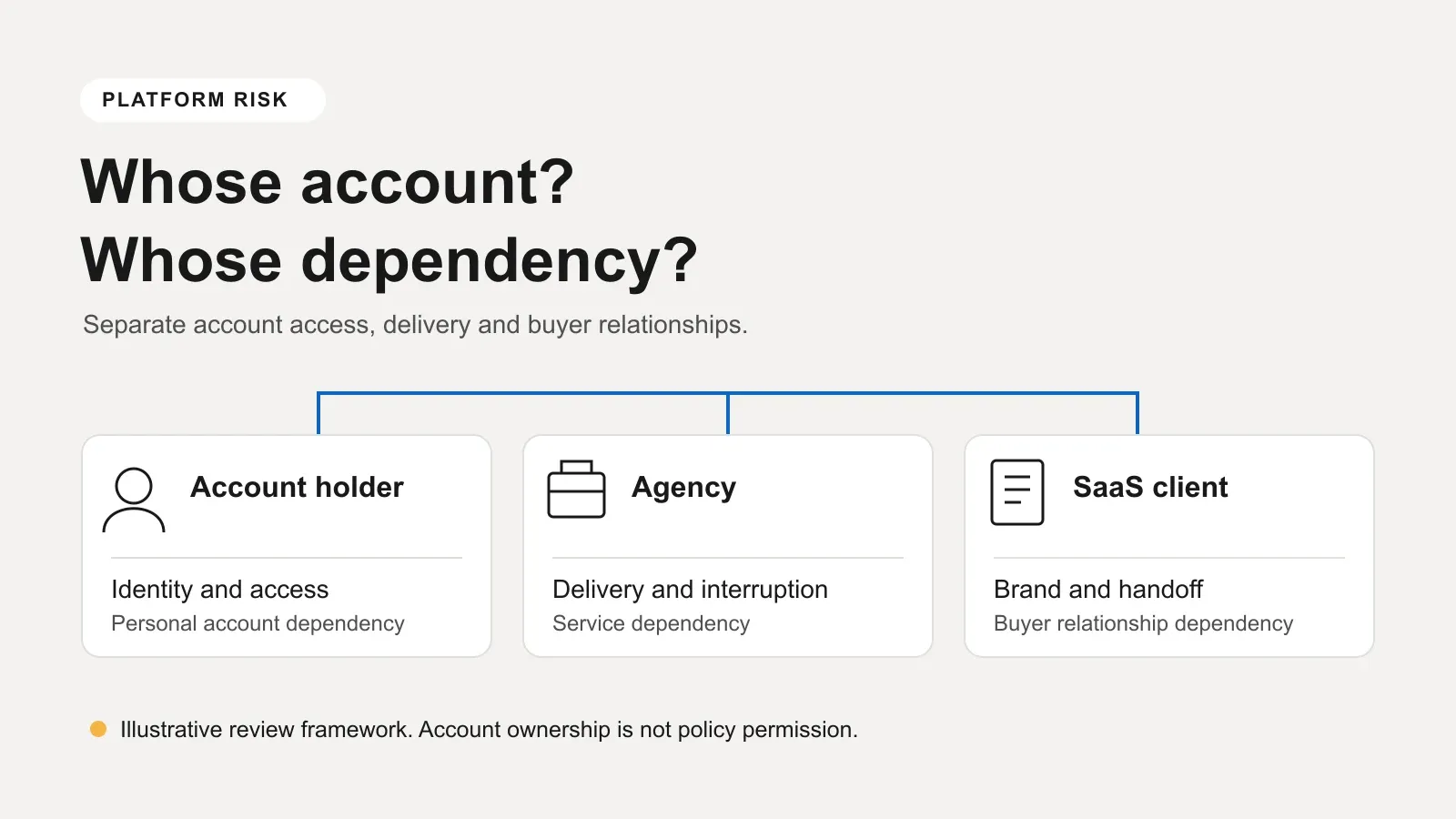
Who carries what when a company uses its people’s accounts?Link to this section
LinkedIn’s account terms say that, as between a member and others, including an employer, the personal account belongs to the member. They assign responsibility for account activity subject to the stated closure or misuse-reporting qualification.[1]
The following allocation is our operational reasoning, not a legal ruling. If a company builds outreach around a founder’s or employee’s profile, that person’s access becomes a business dependency. A restriction could interrupt both the campaign and unrelated professional conversations conducted through that account.
The company should therefore identify the affected person, explain the proposed work to them, and avoid treating their professional identity as interchangeable infrastructure. Ask who writes content, who performs actions and who can stop the work. Do not assume that internal authorization answers LinkedIn’s separate access rules.
For the company, the review should include sales continuity and the employee’s other work. Which active conversations depend on this account? Who can answer a buyer’s question if the usual sender is unavailable? What information has already been recorded elsewhere through a permitted process?
An employment agreement may address responsibilities between the company and its people. Whether it changes rights, creates liability or is enforceable requires qualified advice. It should not be presented as a modification of LinkedIn’s terms.
What changes when an agency uses its own accounts?Link to this section
In this arrangement, distinguish the agency as a service business from the individuals holding personal accounts. Our operational inference is that restriction of a sender’s account can directly disrupt the agency’s delivery, while the client experiences the interruption through its campaign and buyer relationships. The platform warning remains the same.[2]
The owner states that Sapps uses its own LinkedIn accounts, not clients’ personal accounts. That describes whose accounts are used; it does not establish that the activity follows LinkedIn’s rules.
Ask any agency to explain who is represented, how that person is professionally connected to the work and what recipients are told about the commercial relationship. The policies reject fabricated identity and misleading affiliations; they also address benefit-related disclosure.[4] Do not settle for an account label that leaves the actual person and relationship unclear.
The account holder should understand the activity associated with their identity. The agency should be able to describe its operating dependencies and interruption plan. The client should understand what it can review and what it will not control.
For example, if a conversation lives only in an agency sender’s inbox, the client’s access to its context depends on the agreed handoff. That is a dependency to document, not an argument for copying an entire inbox or transferring an account. Ask for relevant, permitted records and a named handoff owner.
What remains with the SaaS client?Link to this section
Not using a client’s personal account does not settle every client risk. Our buyer-review framework separates direct account access from service continuity, brand representation, buyer trust, data handling and commercial commitments.
A client should review product claims before they are made on its behalf. It should understand how an external sender describes the relationship, how objections are handled and where a prospect’s details go. If the outreach stops, the sales team still needs a clear account of which meetings remain scheduled and which conversations need attention.
For U.S. endorsement advertising, the FTC’s guidance says outsourcing a promotional program does not remove the advertiser’s responsibility under the FTC Act. It also discusses potential intermediary responsibility and disclosure of material connections.[6] This is a separate advertising-law issue, not a LinkedIn account rule. Its application to particular content or jurisdictions needs qualified advice.
A contract can describe who pays for unfinished work, who notifies the other party and how disputes are handled. It does not, by itself, tell you what LinkedIn allows. Ask counsel to review the proposed allocation rather than assuming that an agency’s promise to absorb costs settles external obligations.
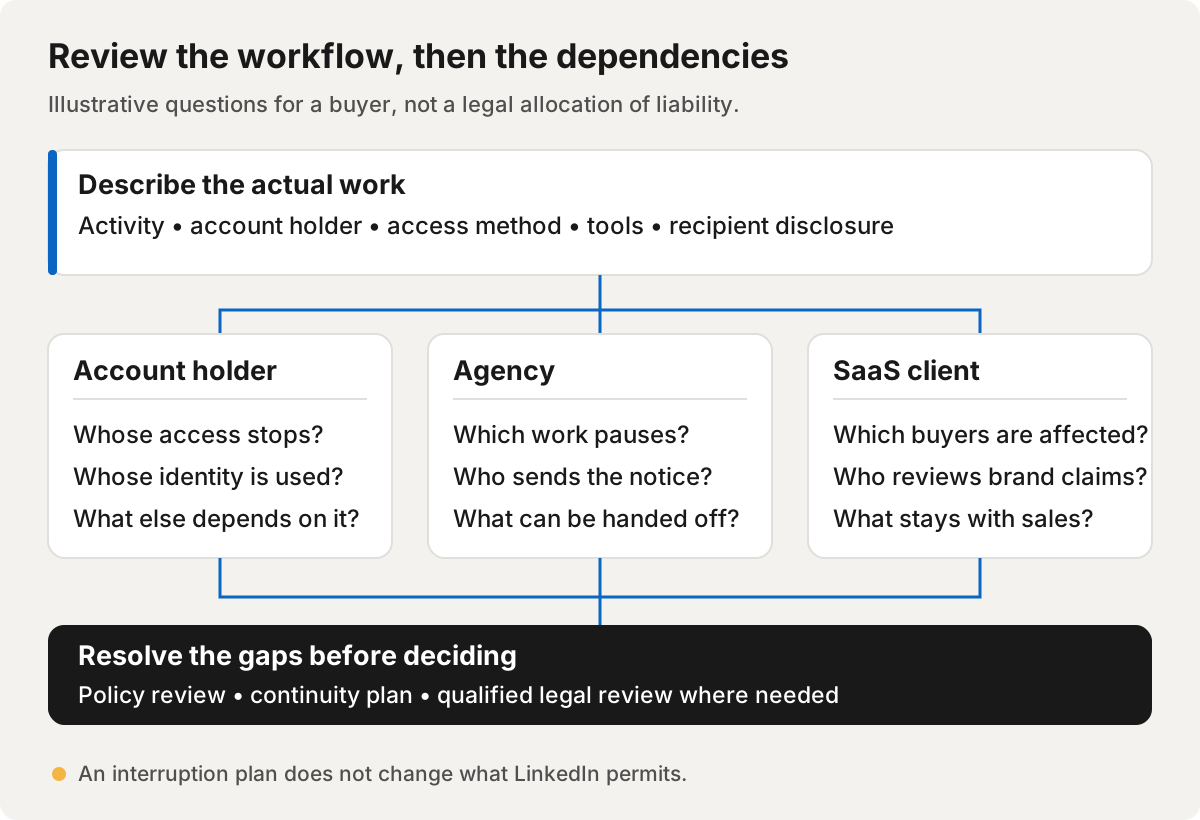
Build a restriction response before you need itLink to this section
This is a planning checklist, not an account-recovery method. It follows the distinction between LinkedIn’s official restriction guidance and your own service arrangements.[3]
Name the notice owner. Specify who will read the platform notification and communicate the facts. Ask the agency to distinguish what LinkedIn has stated from what it suspects. A diagnosis without the actual notice should be marked uncertain.
Define the pause. Identify the activity that stops while the issue is reviewed. Avoid vague continuity promises. Do not write a plan around replacement identities, access workarounds or continuing prohibited activity elsewhere.
Protect existing commitments. Review scheduled meetings and already-established buyer contact routes. Confirm which conversations can be followed up through an existing, appropriate channel. Do not assume every prospect has agreed to contact somewhere else.
Record the handoff. Decide what relevant context can be retained and shared, by whom and for what purpose. Seek advice on privacy and contractual obligations rather than treating data availability as permission to use it.
Clarify the commercial effect. Ask whether work pauses, what remains deliverable and which agreed terms address termination or unresolved deliverables. An agency cannot make LinkedIn’s access decision on your behalf.
Keep the plan proportionate to your actual dependency. A business relying on one person for active negotiations needs a different continuity discussion from a business evaluating a limited campaign with no ongoing conversations. Neither arrangement changes the published policy.
Questions to answer before buyingLink to this section
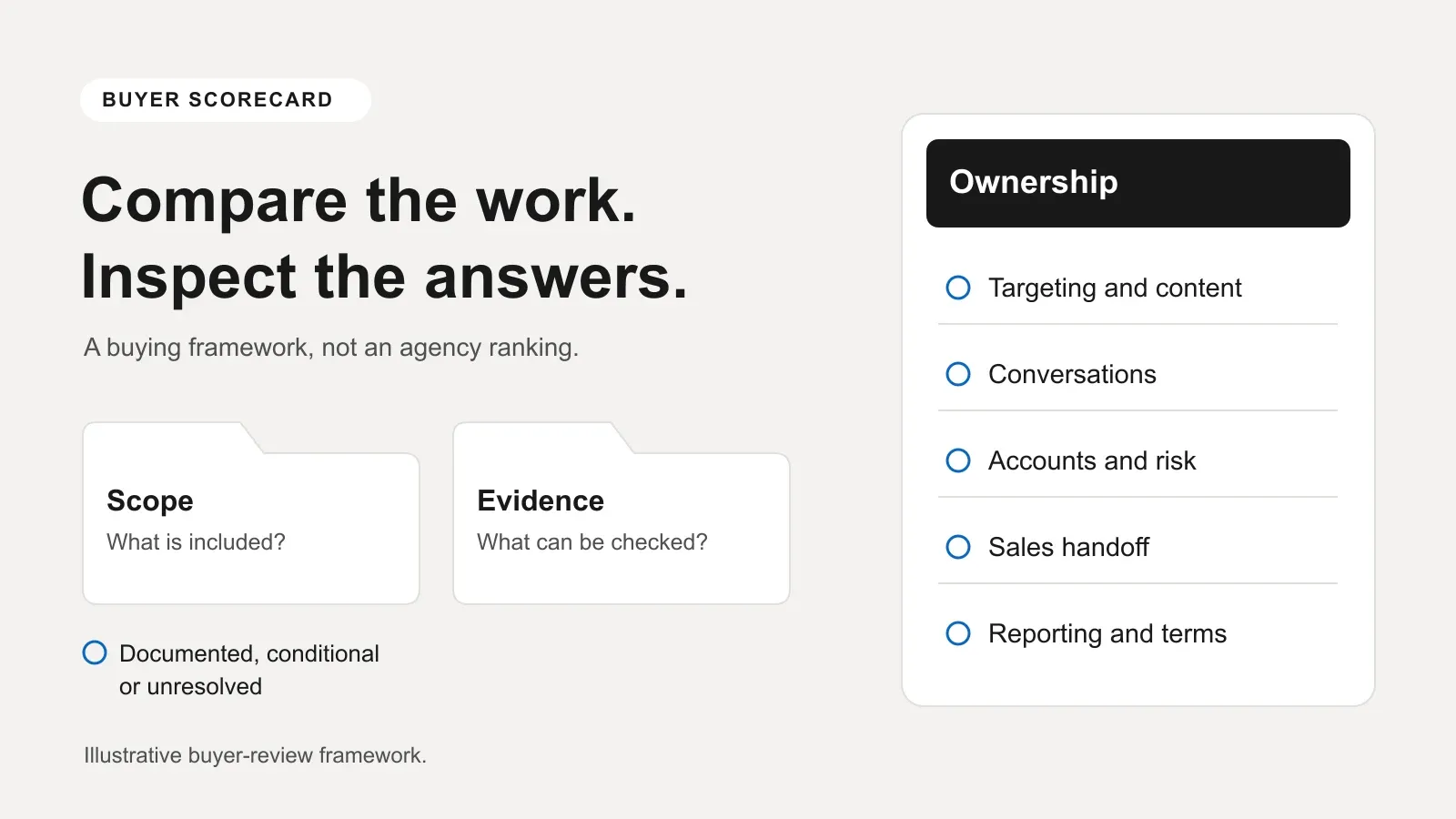
Ask the agency for a written description you can take to your operational and legal reviewers:
- Whose personal accounts perform the work, and who operates them?
- Which tools interact with LinkedIn, and exactly what actions do they perform?
- How do identity, affiliation and commercial disclosures appear to a recipient?
- Who checks product claims and handles a request to stop contact?
- What would a restriction interrupt for each party?
- Which official guidance would the account holder follow?
- What happens to meetings, permitted records, fees and unfinished work?
There is no verified restriction probability in this guide. We did not find a basis in the cited pages for predicting an individual account’s outcome. Do not let an unsupported forecast substitute for the workflow description or contingency plan.
The buying decision is whether you understand the proposed activity and are willing to accept the remaining dependencies after qualified review. Outsourcing may change where an interruption first appears. It does not erase the need to inspect the rules, identity, content and client responsibilities.
If you want to discuss a LinkedIn program for your SaaS, bring these questions to a call with us. We can use them to clarify the proposed scope and the points that need further review.