LinkedIn Agency vs In-House SDR vs Freelancer for a SaaS Startup
Compare ownership, skills, management time and cost components before choosing who runs LinkedIn outbound. Includes an explicitly hypothetical budgeting model.

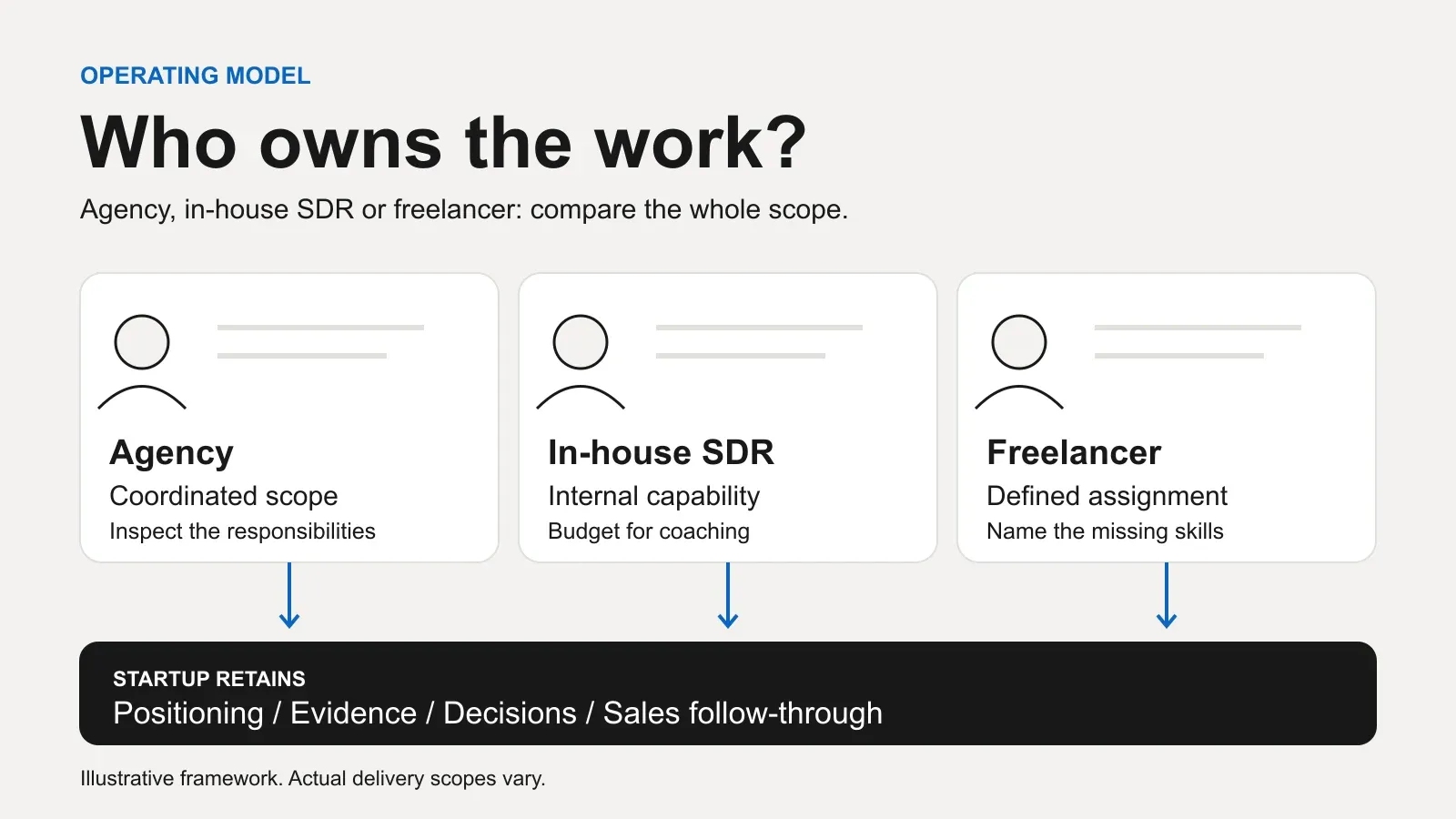
The useful question when comparing a LinkedIn agency vs an in-house SDR is not which label is cheapest. It is which operating model covers the work you need without leaving an unmanageable gap inside your startup.
We would consider an agency when you need a coordinated delivery scope, an in-house sales development representative (SDR) when you want to build an internal prospecting capability, and a freelancer when you can define and supervise a narrower assignment. Those are decision principles, not claims that every provider or hire works the same way.
Compare written responsibilities, retained management time, account dependencies and total cost. None of these models removes your responsibility for product truth or sales follow-through.
Start with the same job, not three different pricesLink to this section
Write a common brief before requesting proposals or opening a job requisition. For a fictional early-stage SaaS company, it could cover:
- Researching a defined ideal customer profile, including excluded companies and roles.
- Preparing relevant introductions and conversations, with clear stop conditions.
- Drafting content from product material that the startup can substantiate.
- Handling replies, recording qualification context and arranging suitable meetings.
- Maintaining a customer relationship management system (CRM) handoff and reporting what happened afterward.
Treat this as a proposed scope, not a description of the whole market. An agency might quote only outreach. A freelancer might specialise in research rather than conversations. Your SDR job description might include email and calling but no content writing.
If you need the entire workflow, our LinkedIn lead-generation overview helps define the work. Remove anything unnecessary before comparing models. Buying more activity than your sales team can handle is not a useful saving.
Also state what is excluded: running sales calls, negotiating contracts, creating unsupported customer stories or deciding legal questions. Otherwise a low headline price can simply reflect a smaller assignment.
An ownership matrix you can adaptLink to this section
The matrix below is illustrative. It assumes an agency with a coordinated scope, an employee focused on prospecting, and a freelancer contracted for research and outreach. Change the cells to match the actual agreement.
“Startup” means a named internal decision-maker, not an unowned task. “Shared” needs an explicit executor and reviewer.
| Responsibility | Agency model | In-house SDR model | Freelancer model |
|---|---|---|---|
| Choose segment and product positioning | Startup decides; agency advises | Startup decides; SDR contributes research | Startup decides and briefs |
| Research prospects and exclusions | Agency executes; startup reviews fit | SDR executes; manager reviews | Freelancer executes contracted research |
| Draft content and messages | Agency drafts if included; startup verifies claims | SDR drafts outreach; content needs a separate owner | Freelancer drafts agreed material; gaps stay internal |
| Review platform and privacy questions | Startup and agency each name a reviewer | Startup names reviewer; SDR follows the process | Startup and freelancer each name a reviewer |
| Handle replies and qualify interest | Agency within agreed boundaries | SDR with coaching and escalation | Freelancer within written coverage |
| Book and record a handoff | Agency; startup defines acceptance | SDR; sales team accepts | Freelancer; startup checks completeness |
| Run calls, follow up and close | Startup | Startup sales owner | Startup |
| Preserve learning and reporting | Shared, with agreed delivery of records | Startup maintains process and records | Startup requires documented handover |
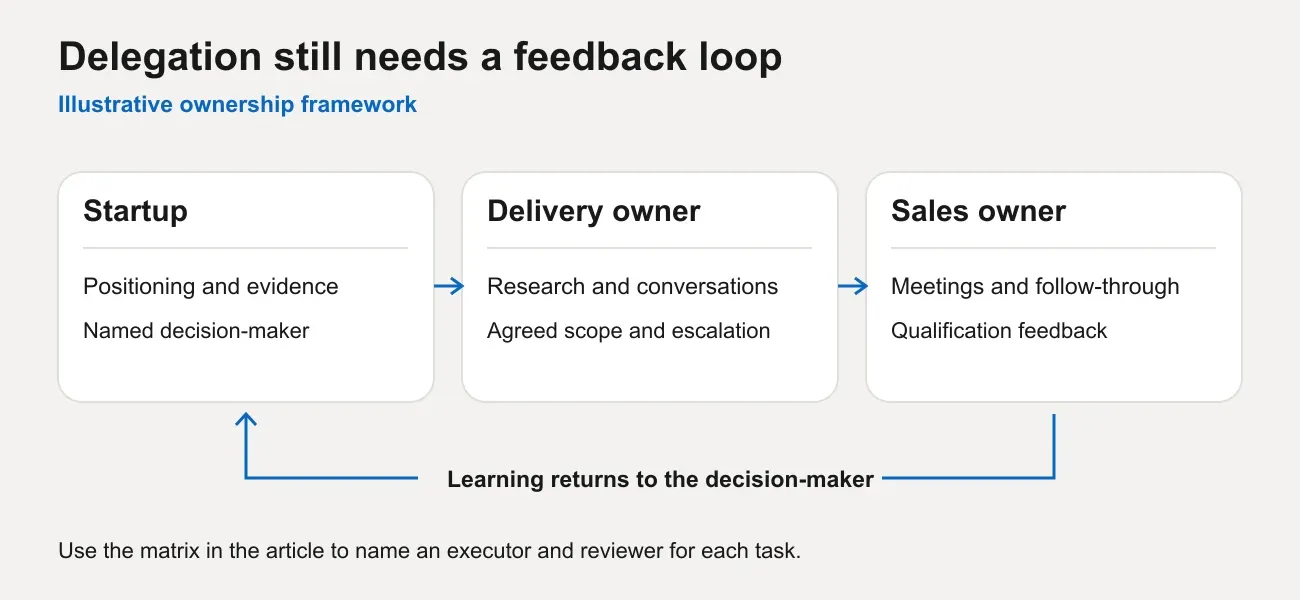
Ask whoever owns delivery to explain what happens when a prospect asks about security, an integration or pricing. The answer should identify an escalation route, not permission to improvise.
Match skills to the workLink to this section
Use a work-based evaluation rather than assuming a job title proves competence. Give each candidate the same fictional product brief and ask them to explain a targeting choice, rewrite an unclear message and distinguish a relevant reply from a meeting request.
Agency: Ask who does research, writing, conversation handling and reporting. Request the proposed division of labour and review process. A team-shaped proposal is useful only if those roles are actually included and somebody coordinates them.
In-house SDR: Evaluate research judgement, listening, writing, recordkeeping and willingness to escalate product questions. If the role also needs content strategy or technical discovery, describe that explicitly rather than hiding it inside “outbound.”
Freelancer: Look for a close match between their specialism and your assignment. A strong writer need not be a strong qualifier. A capable researcher need not want responsibility for live replies. Decide how the missing skills will be supplied internally.
In every model, ask how the operator learns your product and incorporates feedback. For a technically complex SaaS offer, the startup should name a product specialist who can answer questions without turning every conversation into a founder interruption.
Management time belongs in the comparisonLink to this section
We recommend separating delivery time from the time you spend directing it. Your calendar needs room for decisions, product explanations, approvals, coaching and meeting feedback regardless of the contract type.
For an agency proposal, inspect the client-input list and who consolidates feedback. For a hire, budget for recruiting, onboarding, coaching and reviewing qualification decisions. For a freelancer, define briefs, availability, revisions and what happens when the assignment changes.
Do not assume an agency is hands-off, an employee is immediately autonomous or a freelancer always needs more supervision. The relevant question is how much direction this scope and this person or team require from you.
During a pilot, keep a log of retained work: time spent explaining the product, resolving exceptions, correcting handoffs and reviewing messages. Compare that observed effort with your budget. Repeated corrections suggest a scope, training or quality problem worth investigating, not automatically a reason to change the operating model.
Account responsibility is not the same as business ownershipLink to this section
LinkedIn prohibits third-party software that scrapes or automates activity on its site. It says members using prohibited tools risk restriction or account closure.[2] Its User Agreement requires truthful identity, prohibits sharing or transferring personal accounts, and says the personal account belongs to the member even in an employment relationship.[3]
At Sapps Leadgen, we run LinkedIn activity for B2B SaaS clients using our own LinkedIn accounts, not the client’s personal account. That describes our operating model; it does not establish permission under LinkedIn’s rules.
As an operational distinction, an agency using its own accounts puts direct account-restriction exposure on those account holders. The client can still face interrupted conversations, brand concerns and lost context. If a startup uses its people’s accounts, a restriction affects those people and the company’s workflow. These are dependency considerations, not legal conclusions.
Ask how conversation context reaches your sales team and what remains available if the engagement ends. Do not treat connections as a company-owned asset that can simply transfer with a contract. Get qualified advice on account access, privacy and contractual responsibilities where interpretation is needed.
What public wage data can and cannot tell youLink to this section
BLS reports a May 2025 U.S. median annual wage of $124,900 for sales engineers. That occupation sells technical products or services and includes responsibilities beyond prospecting. Its Occupational Employment and Wage Statistics (OEWS) wage series includes sales commissions and production bonuses, excludes self-employed workers, and is not an employer’s fully loaded cost.[1]
This is not an SDR salary benchmark, a freelancer rate or a SaaS-startup hiring quote. We do not use it to set the employee budget below. For an actual hire, obtain compensation evidence matched to duties, location, seniority and incentive structure, then separately calculate employer costs. Avoid adding commission twice when a wage measure already includes it.
Hypothetical monthly cost tableLink to this section
Assume one fictional startup compares a scoped agency engagement, a full-time employee, and a freelancer allocated 60 delivery hours per month at $60 per hour. These do not represent equivalent capacity. We assign $100 per retained management hour as an opportunity-cost assumption, not an additional cash payment.
| Monthly component | Agency assumption | In-house SDR assumption | Freelancer assumption |
|---|---|---|---|
| Delivery fee or employee cash compensation budget | $5,000 | $6,000 | $3,600 |
| Employer taxes and benefits allowance | Included in fee assumption | $1,500 | Included in fee assumption |
| Startup-paid tools and operations | $250 | $500 | $400 |
| Separate content support | Included in scope assumption | $500 | $300 |
| Recurring cash subtotal | $5,250 | $8,500 | $4,300 |
| Retained startup management hours | 8 | 20 | 16 |
| Imputed management cost at $100/hour | $800 | $2,000 | $1,600 |
| Recurring economic total | $6,050 | $10,500 | $5,900 |
The employee’s $1,500 allowance is an assumed 25% of the $6,000 cash budget, not a statutory rate. Replace it with actual payroll, benefit and employment inputs for your jurisdiction. The delivery budgets assume variable compensation is already included; any separately quoted performance fee must be added without double counting.
Formula: economic total = recurring cash subtotal + retained hours × assumed hourly value. Initial setup, recruiting, ramp time, equipment, termination costs and applicable purchase taxes are excluded. Budget those separately over your intended evaluation period; do not hide them in a steady-state monthly comparison.
Changing the assumptions can change the ordering. In this illustration, another four management hours add $400 of imputed cost. If content is not included in an agency scope, add it there too. The table cannot tell you cost per qualified meeting because it assumes no meeting output.
Choose the constraint you can actually manageLink to this section
Consider these fictional situations, not empirical rules:
A founder is still learning the buyer’s problem. Keep close ownership of conversations and product decisions. A narrow research or writing assignment may be easier to direct than delegating a whole process that is still changing.
A startup has a clear segment but lacks delivery coordination. Evaluate an agency against a complete responsibility map. Check whether the proposed scope closes those gaps and what decisions remain on your side. Use our agency-selection checklist to inspect the proposal.
A sales leader wants an internal capability across channels. An SDR hire may fit that intention, provided the leader can coach, provide product access and preserve learning. Budget the management work rather than describing it as free because it happens inside the company.
Before choosing, write down the records you expect: message versions, segment decisions, reply classifications, meeting context and reasons sales rejected a handoff. Define a review point around learning and delivery quality, not an invented meeting target. Confirm who can pause activity and how outstanding conversations will be handled.
The better model is the one whose scope, supervision and dependencies fit your current organisation. If you want to explore whether an agency belongs in that comparison, you can book a call with us and bring your responsibility map.