A LinkedIn Content Strategy Built Around SaaS Buyer Questions
Build a B2B SaaS content plan around problems, evaluation questions, objections and next steps, with a buyer-question matrix and a path to relevant conversations.

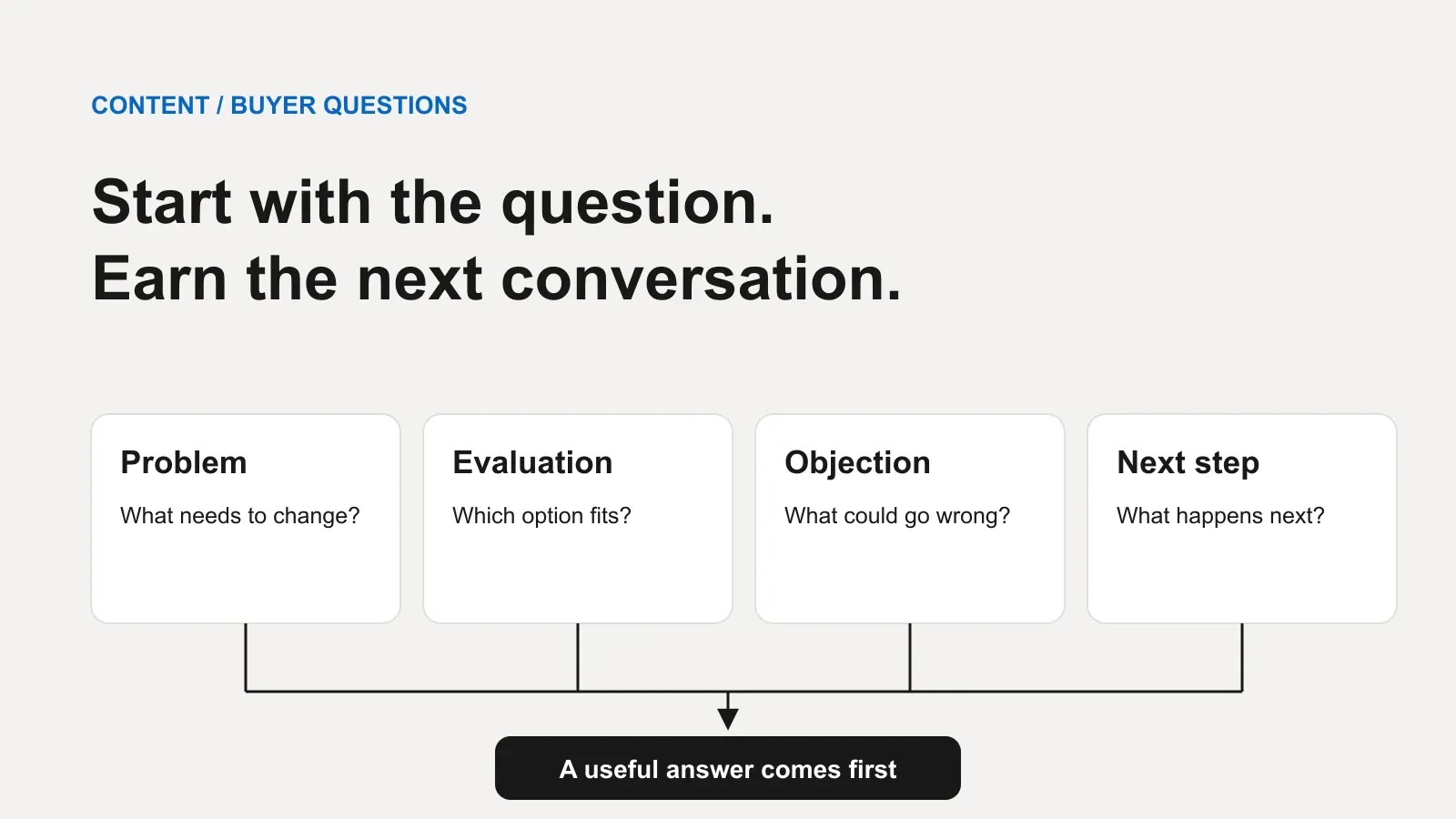
A useful LinkedIn content strategy for B2B SaaS starts with the questions buyers need to resolve, not a list of formats to publish. Organize those questions around the problem, the evaluation, the objection and the next step. Then write an answer that remains useful even if the reader never contacts you.
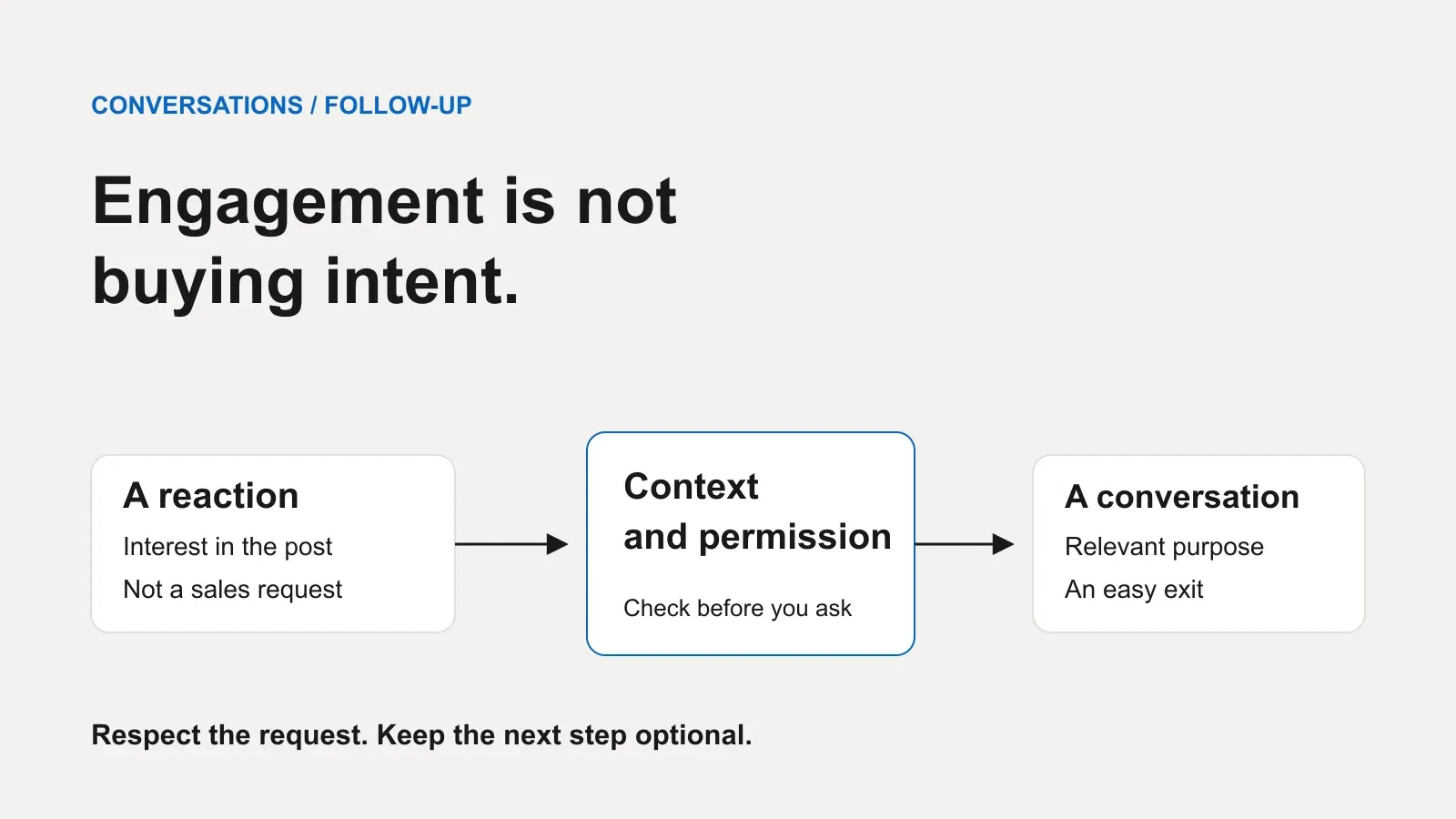
Engagement can help you notice a topic. It should not replace the question of whether the content helps the right person make a decision. A thoughtful comment is not a purchase request, and a quiet reader is not necessarily an irrelevant reader.
The framework below is our editorial recommendation, not a proven conversion sequence. Use it to connect audience definition, evidence, publishing and conversations without promising that attention becomes pipeline.
What the research supports, and what it does notLink to this section
The 2024 Edelman–LinkedIn report surveyed 3,484 business executives through LinkedIn, in English, across the US, Canada, UK, Germany, Singapore, Australia and India. Fieldwork ran from November 30 to December 14, 2023. Its definition of thought leadership excludes content primarily describing products or services. Among surveyed decision-makers who consume thought leadership, 73% agreed they trusted thought leadership more than product sheets and other marketing collateral when judging a supplier’s competence. This is the top-two agreement result on a five-point scale, averaged across the seven countries.[1]
LinkedIn’s 2024 B2B Marketing Benchmark, commissioned from Ipsos, used an online survey of over 2,000 B2B marketing leaders, including 448 chief marketing officers, across the US, UK, Germany, France, India, Australia, Singapore and Brazil from March 1–29, 2024. LinkedIn reported that 88% of those CMOs agreed relationship building was important to success in the year ahead.[2]
These are broad, self-reported B2B findings, not SaaS-only experiments or evidence that a particular LinkedIn post caused a sale. We use them as a reason to test useful explanations and relationships, not to forecast results.
Choose a buyer and a decision before choosing a topicLink to this section
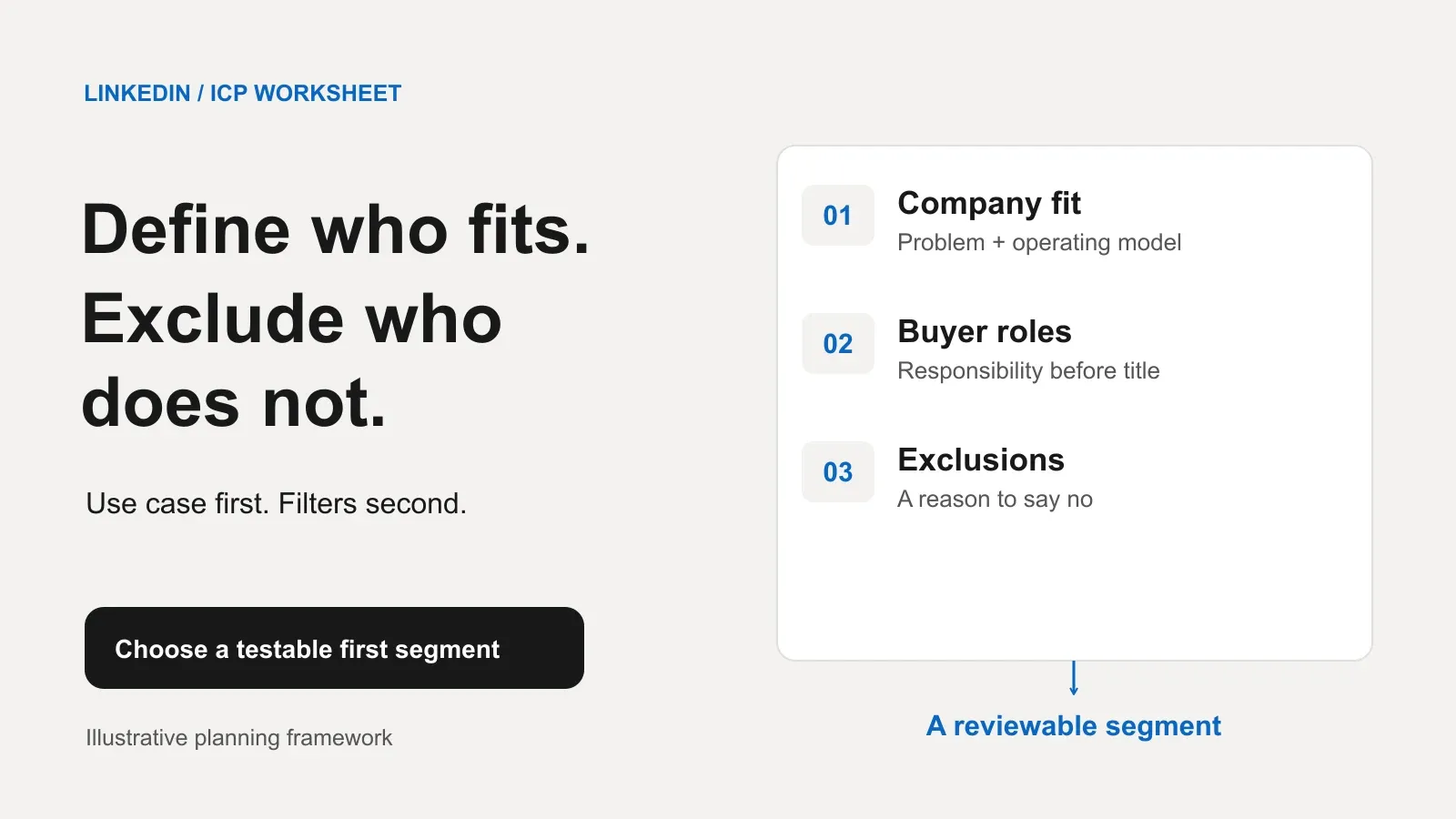
Start with a working ideal customer profile, or ICP: the company conditions and buyer roles that make your product relevant. If that is still vague, use our guide to defining a B2B SaaS ICP for LinkedIn before building the calendar.
For each proposed topic, write down the role, the situation, the decision and the information missing. “Operations leaders” is an audience label. “An operations leader deciding whether recurring handoff failures require a process change or new software” is an editorial brief.
Ask sales, product and customer-facing colleagues for questions they can support with actual conversations or documentation. Separate what someone really asked from what your team thinks they might ask. Keep identifying details out of the brief unless their use has been properly reviewed.
Do not let one confident anecdote become a claim about the entire market. An unanswered question can be a useful content hypothesis. It does not need to become an invented buyer statistic.
Build a buyer-question matrixLink to this section
This matrix uses a fictional workflow SaaS company, Alderloop, and invented buyer questions. The categories are editorial tools, not mandatory stages that every buyer follows.
| Question category | Fictional buyer question | Useful content answer | Evidence to gather before publishing | Optional next step |
|---|---|---|---|---|
| Problem | Why do handoffs keep stalling even when everyone updates the tracker? | Explain how to distinguish unclear ownership from missing software. | A documented process map; clearly labelled hypothetical scenarios. | Invite readers to compare their own process. |
| Evaluation | Should we change the workflow, build internally or buy a tool? | Show the trade-offs and situations where each option fits. | Current product documentation and explicit assumptions. | Offer an evaluation worksheet without requiring a call. |
| Objection | Will another tool create more admin work? | Explain who maintains the workflow and what work remains manual. | Verified implementation responsibilities and known limitations. | Answer a specific workload question in the comments. |
| Next step | What should we prepare before a fit conversation? | List the process, stakeholders and constraints worth discussing. | A reviewed discovery agenda and actual product boundaries. | Let the reader request a conversation. |
Add an owner and a review status in your internal version. A row is ready for writing only when the team can explain what it knows, what it assumes and what it still needs to verify.
Problem content: help someone diagnoseLink to this section
Lead with a recognizable situation rather than a product feature. In the fictional example, a post could explain how to inspect the point where responsibility moves between teams. The useful answer is a diagnosis method, not “our software fixes handoffs.”
Include a situation where software is not the answer. If ownership is unclear, adding a tracker may leave the underlying decision unresolved. Present this as reasoning to test, not as a finding about all operations teams.
Evaluation content: make trade-offs visibleLink to this section
Give the reader criteria they can reuse. Compare process redesign, an internal build and an external product on maintenance, flexibility, ownership and implementation work. Do not turn the comparison into a table where your product wins every row.
Explain which inputs would change the recommendation. If the answer depends on integrations or data requirements, say so. Verify feature claims against current documentation and identify anything that remains unknown.
Objection content: answer the cost of changeLink to this section
Treat an objection as an unresolved question rather than resistance to overcome. “Who maintains this?” needs a responsibility breakdown, not a motivational paragraph about innovation.
Ask a product or implementation owner to review the answer. Do not invent deployment times, security assurances or savings. If the team cannot yet substantiate a claim, publish a question checklist or acknowledge the limitation instead.
Next-step content: make the conversation intelligibleLink to this section
Explain what a reader would discuss and what they would need to bring. A useful discovery agenda can include the workflow, its current owner, the constraint and the decision being considered.
Keep a non-meeting option available. Someone who wants a worksheet should not have to accept a sales conversation to obtain it. A clear next step lets the reader choose; it does not manufacture urgency.
Turn each row into an evidence-backed postLink to this section
Use a compact brief with these fields:
- Buyer question: the specific uncertainty being addressed.
- Answer: the main point, including when it would not apply.
- Evidence: the source, its date, its scope and what it actually supports.
- Illustration: a clearly fictional scenario if real material is unavailable.
- Reader action: a question, worksheet or optional conversation connected to the answer.
- Reviewer: the person responsible for checking the claims.
Our suggested post structure is situation, explanation, evidence, limitation and optional action. This is a writing scaffold, not a required format or a claim about the algorithm.
For research-led posts, keep the method next to the finding. A survey of marketers’ beliefs is not a measurement of buyers’ behavior. A broad B2B result is not your product’s result. Product documentation establishes a capability, not the financial value a reader will receive.
Match the format to the questionLink to this section
LinkedIn’s Page content guidance recommends asking relevant questions and responding to the discussion, and says not every post should focus on the business or product.[3] Treat that as platform guidance for Pages, not proof that a format will work equally well from every profile.
For our matrix, a process diagram suits the problem question; a readable comparison suits evaluation; a responsibility checklist suits the objection; and a discovery agenda suits the next step. Choose the format that makes the answer easier to understand.
Keep diagrams legible on a phone. Explain charts in prose and give images meaningful alternative text. If a visual depicts an invented conversation or company, label it clearly. Do not dress a fictional exchange as evidence of a real customer outcome.
Connect content to a conversation without assuming intentLink to this section
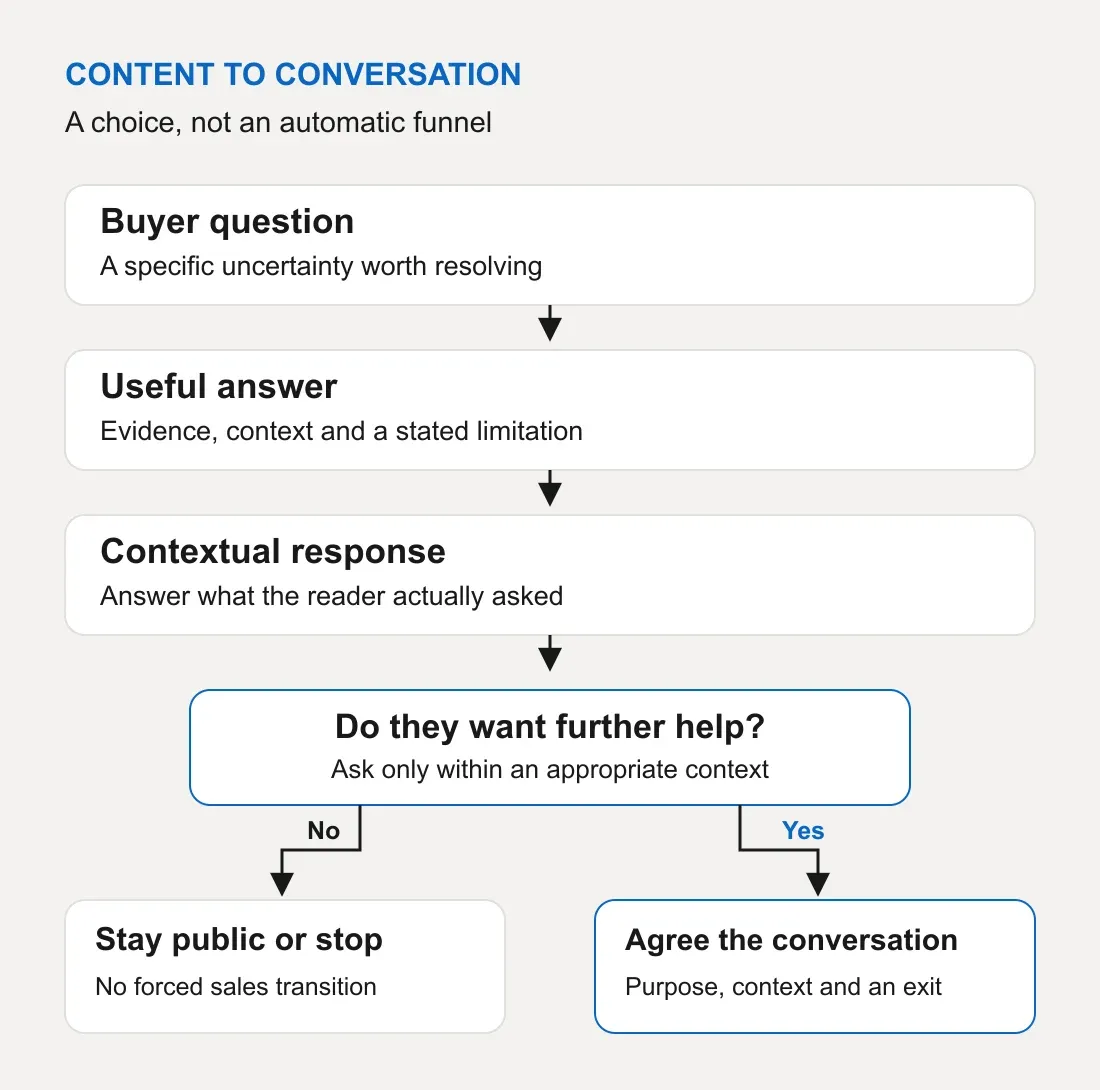
Answer a public question publicly when that is appropriate. If a reader asks for a worksheet, provide what was requested. If they describe a relevant problem, clarify whether they want further help before changing the interaction into a sales conversation.
An engagement total cannot tell you that every participant wants a message. LinkedIn prohibits promotional messaging that is irrelevant, plainly unwelcome or needlessly repeated, and arrangements to artificially increase engagement.[4] Our recommendation is to preserve context and leave an easy exit, rather than treat a reaction as permission.
If someone asks to speak, summarize the question and agree the purpose before handing it to sales. The LinkedIn-to-sales handoff checklist explains what to record without turning a booked appointment into an assumed opportunity.
Review the questions, not just the reachLink to this section
Keep a lightweight editorial log containing the topic, intended role, question category, evidence used, substantive responses and questions left unanswered. Record an agreed conversation separately from a reaction or a resource request.
Use those observations to form hypotheses, not to declare that one category of post has proven superior. If a post attracts broad discussion but little relevant buyer context, inspect the question and audience before deciding the content failed. If a narrow post produces a useful evaluation question, consider expanding that answer without declaring a revenue effect.
Ask sales whether the material helped explain something during an actual conversation. Record what they observed and what they could not establish. A remembered post or a buyer’s statement can be useful context; neither proves that the content caused the deal.
Review for gaps across the matrix, not a fixed ratio of post types. A backlog full of problem explanations may need evaluation detail. A backlog full of product updates may need clearer diagnosis. There is no supported universal posting mix in this framework.
Before scheduling the next piece, confirm that its question is specific, its answer stands alone, its evidence is reviewable and its next step is genuinely optional. That is a usable content strategy even before you know which topics will earn attention.
If you want to discuss how buyer questions could shape your LinkedIn content and outreach, book a call with us. We can review the audience, evidence and conversation boundaries with you.