LinkedIn Lead Generation for B2B SaaS: From ICP to Sales Meeting
A practical LinkedIn workflow for B2B SaaS teams, with targeting decisions, buyer-focused content, respectful conversations, stage ownership, sales handoff and measurement.

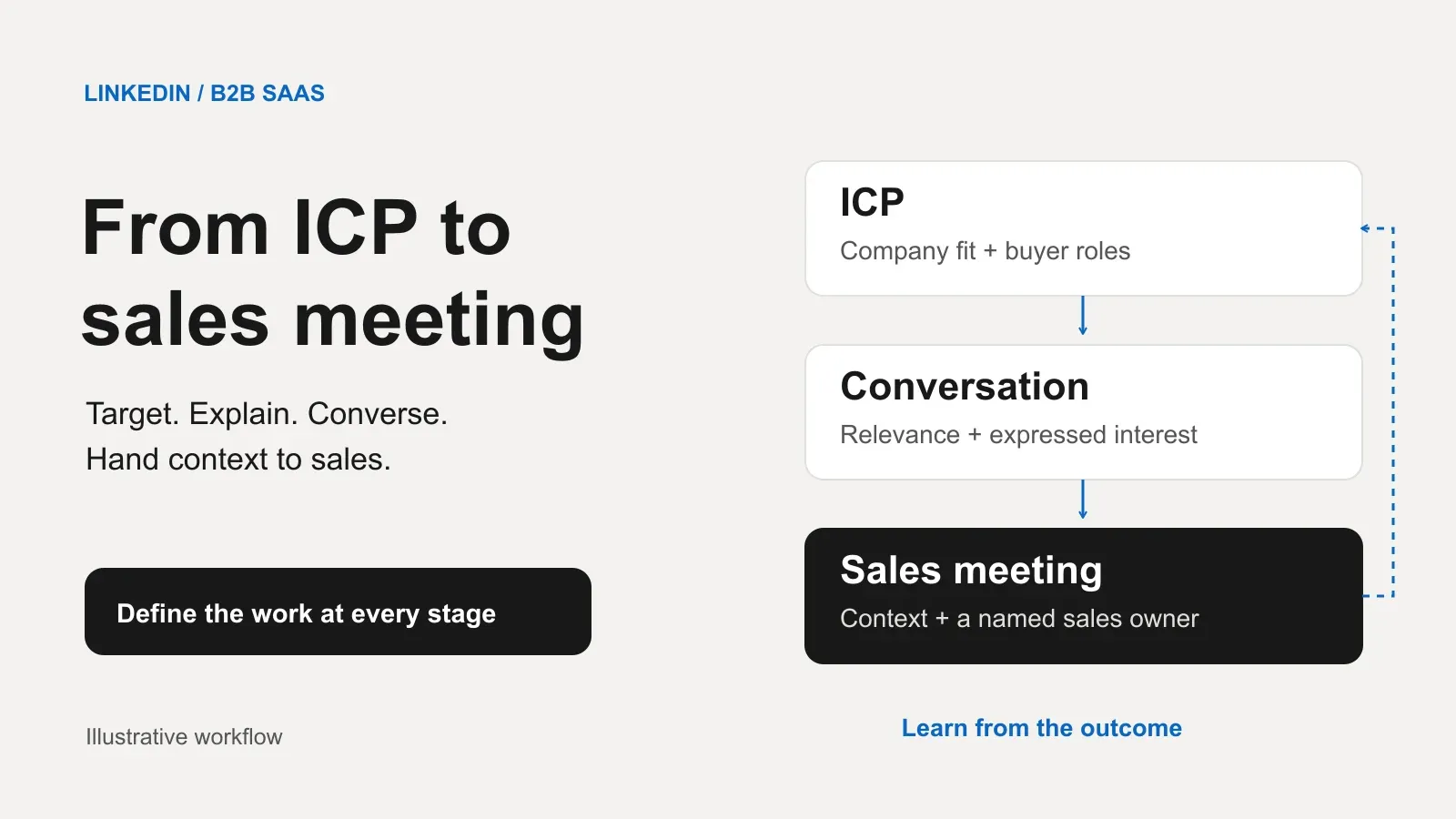
LinkedIn lead generation for B2B SaaS should be a connected workflow, not a target for connection requests. Start with a company problem your product can address, identify the people involved, publish useful material, develop relevant conversations, and hand sales a meeting with context. Measure what happens after the calendar invitation, too.
We recommend treating each transition as a decision. An account can match your search without matching your product. A connection can accept without wanting to buy. A prospect can book without attending. Keeping those distinctions visible makes the programme easier to judge and improve.
This guide maps the whole process. The worksheets and checklists linked below go deeper into individual stages; none of the stages should be treated as automatic permission to move to the next.
Start with a channel decision, not a volume targetLink to this section
Before building a list, ask whether you can explain a useful reason for the intended buyer to talk with you. Write down the problem, the product’s relevant capability, the evidence you can share, and who will take a sales conversation. If those answers are missing, work on them before expanding activity.
Then make a channel hypothesis: the intended roles can be identified here, the topic belongs in a professional conversation, and your team can support the follow-through. Verify that hypothesis through research and actual conversations rather than assuming every SaaS buyer is reachable or interested.
LinkedIn’s Sales Navigator documentation describes company and role filters, including headcount, headquarters location, current job title, function and seniority. These are research inputs, not evidence of budget or a live project.[1]
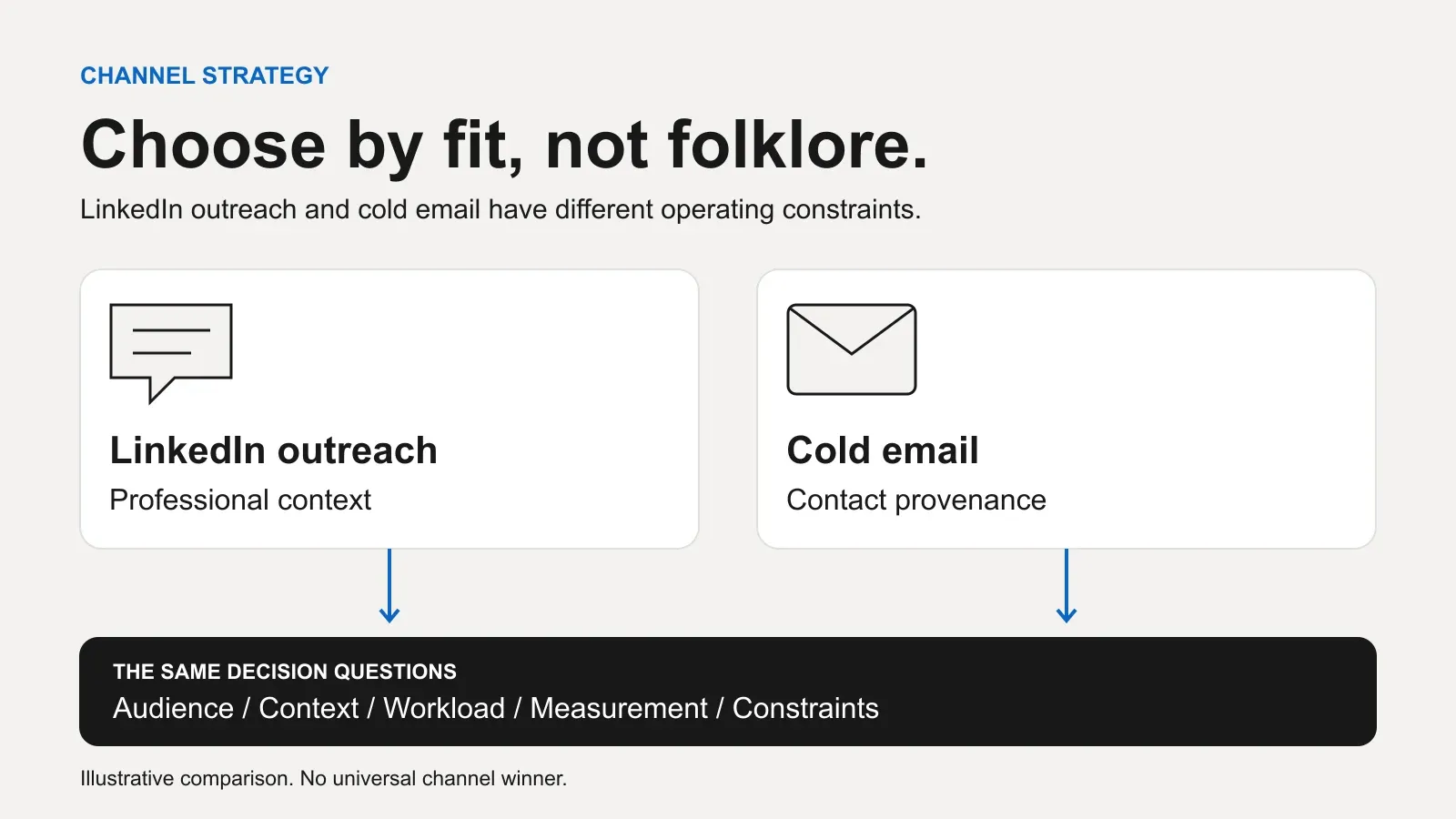
Keep the initial scope narrow enough to review the people you intend to approach. Also consider where LinkedIn is the wrong starting point: an unclear use case, no available sales owner, or no evidence that the target roles use the channel for relevant professional discussion. Our LinkedIn outreach versus cold email guide provides a separate channel comparison rather than declaring a universal winner.
Give every stage an owner and an exit conditionLink to this section
The following is our proposed operating framework, not a description of measured client results. A small team may assign several responsibilities to one person. An outsourced team should still name the client decision-maker at each handoff.
| Stage | Working owner | Client responsibility | Exit condition |
|---|---|---|---|
| ICP and segment | Research or growth lead | Confirm use case, exclusions and product fit | A reviewable segment with an evidence trail |
| Connections and introductions | Outreach owner | Confirm identity, representation and boundaries | An appropriate interaction, not presumed buying intent |
| Buyer-focused content | Editorial owner | Verify product statements and supporting evidence | Useful published material with a defined buyer question |
| Conversations | Conversation owner | Clarify qualification and stop conditions | Expressed interest and a relevant next step |
| Meeting handoff | Scheduling owner | Name the salesperson and available capacity | Context delivered and receipt confirmed |
| Sales follow-through | Client sales owner | Hold the call and record disposition | A documented next step or reason to close |
| Measurement and learning | Reporting owner | Reconcile sales outcomes and definitions | A decision about what to keep, change or stop |
The exit conditions matter more than a list of deliverables. A spreadsheet of names is not a reviewed segment. A calendar event is not a completed handoff. A report of replies is not a report of qualified opportunities.
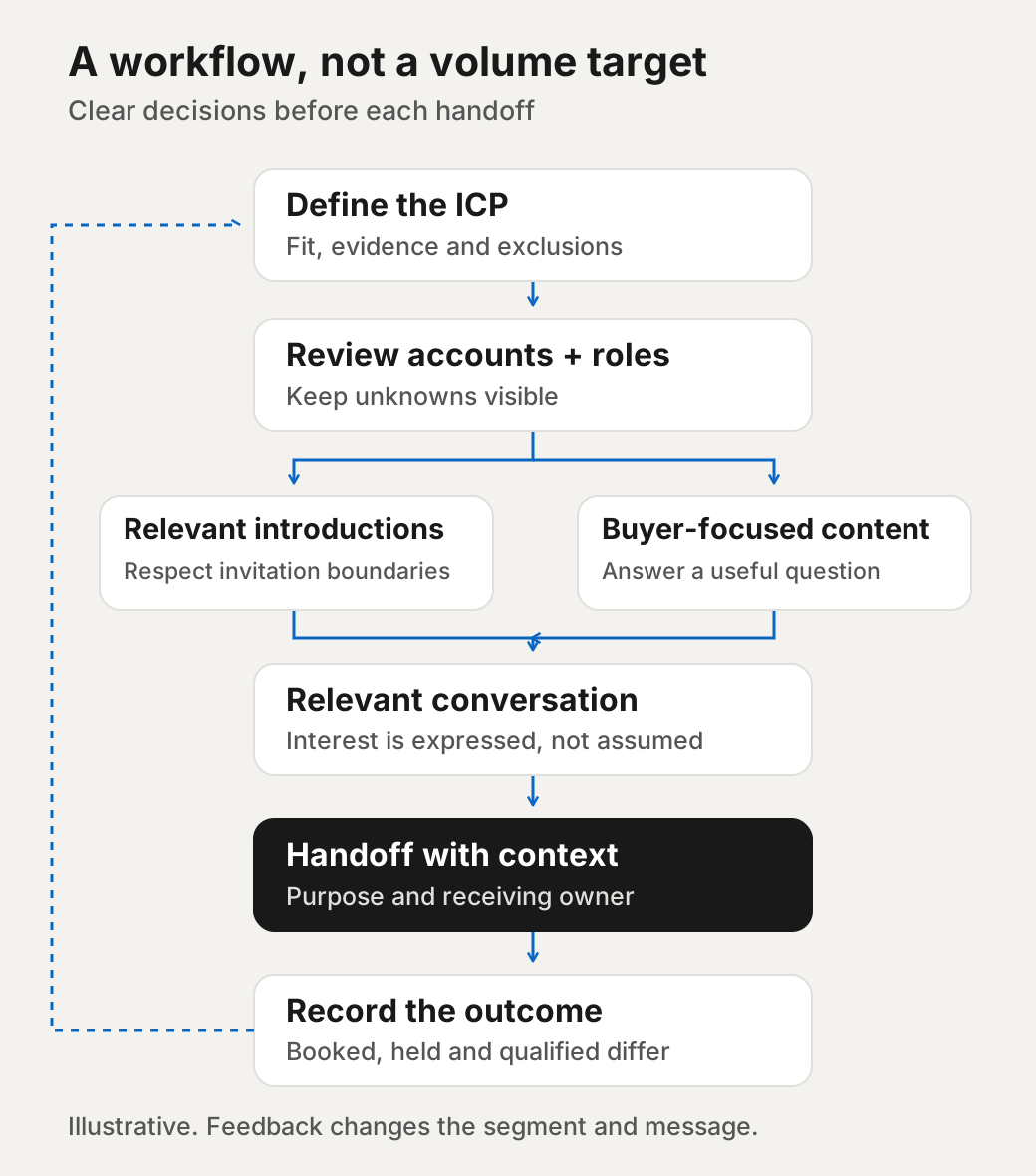
Use the diagram as a map of responsibilities, not a rigid sequence. Content can prompt a conversation before a connection exists. An existing relationship can make an introduction more appropriate. A sales call can reveal that the original segment was wrong. Record those routes instead of forcing every prospect into the same path.
Define the ICP before building the audienceLink to this section
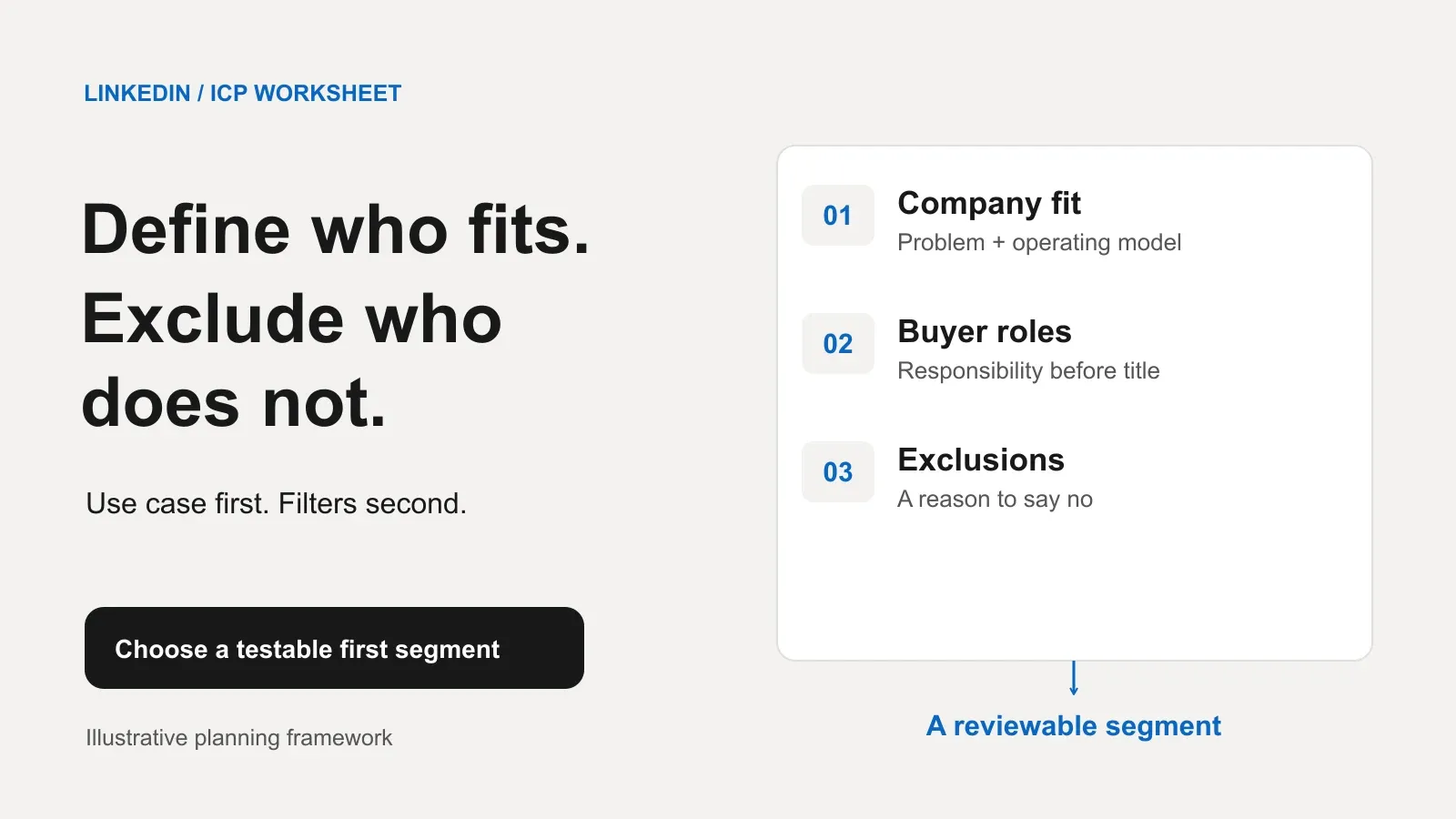
An ideal customer profile, or ICP, is your working definition of the companies most likely to have a problem your product can meaningfully address. Separate that company definition from the people who use, evaluate, fund or review a purchase.
Write company criteria in terms of a product use case. Include operating model, relevant workflows, geography you can serve, implementation requirements and explicit exclusions. Use size or industry to help find candidates, but require a reason those attributes matter to the problem.
For example, an illustrative SaaS product for coordinating customer onboarding might focus on companies where sales, implementation and customer success share responsibility for a handover. That is a problem hypothesis, not proof that any company with those departments needs the product.
Identify the likely working owner of that problem and the roles that could evaluate or block a change. Do not assume a senior title means purchase authority. Put unverified budget, current tools and project timing in an unknown column rather than filling them in from a job title.
The B2B SaaS ICP worksheet turns those decisions into company criteria, role hypotheses, exclusions and an initial testable segment.
Connections need context, not a disguised pitchLink to this section
Treat the introduction as a relationship decision. Can the sender truthfully explain who they are, how they relate to the business, and why the interaction is relevant? Do not invent a shared experience or imply the sender works for the prospect’s company.
LinkedIn recommends inviting people you know and trust. Its invitation guidance identifies ignored, pending or spam-marked invitations and concentrated sending as possible restriction factors. It does not supply a daily allowance we can describe as protective.[2]
Its community policies also prohibit using invitations to send promotional messages to people you do not know, alongside unwanted or repetitive messaging.[3] A prospect matching your ICP does not cancel those boundaries.
For that reason, the invitation stage should not be built around hiding a sales pitch in a personal note. Explain genuine context where an invitation is appropriate, respect non-response, and do not treat acceptance as a request for a product presentation. Record the relationship state separately from commercial interest.
Content should help a buyer thinkLink to this section
Choose a question the intended reader needs to resolve. Useful categories include diagnosing the problem, comparing approaches, understanding implementation, and evaluating limitations. Give the reader an answer they can use without booking anything.
For the fictional onboarding product, a post could examine where ownership becomes unclear between a signed contract and implementation. Another could explain which handover fields matter and which create unnecessary work. These are illustrative editorial ideas, not customer stories or performance evidence.
There is relevant buyer research, but its scope matters. The 2025 Edelman–LinkedIn report surveyed 1,934 executives online through LinkedIn, with fieldwork from March 17 to April 3, 2025. Its study-method page identifies the United States as the surveyed market, despite broader wording elsewhere. It reports that buyers outside the product’s expert-user roles also use thought leadership when evaluating vendors.[4]
That self-reported, cross-industry research is a reason to consider more than the obvious user in your content planning. It is not a SaaS outreach benchmark, a causal test of posting, or evidence that engagement produces meetings.
Attach an evidence check to each proposed post. Distinguish product documentation, independently sourced research and editorial reasoning. Leave out an outcome claim you cannot substantiate. The buyer-focused content strategy guide develops the editorial plan in more detail.
Move from engagement to a relevant conversationLink to this section
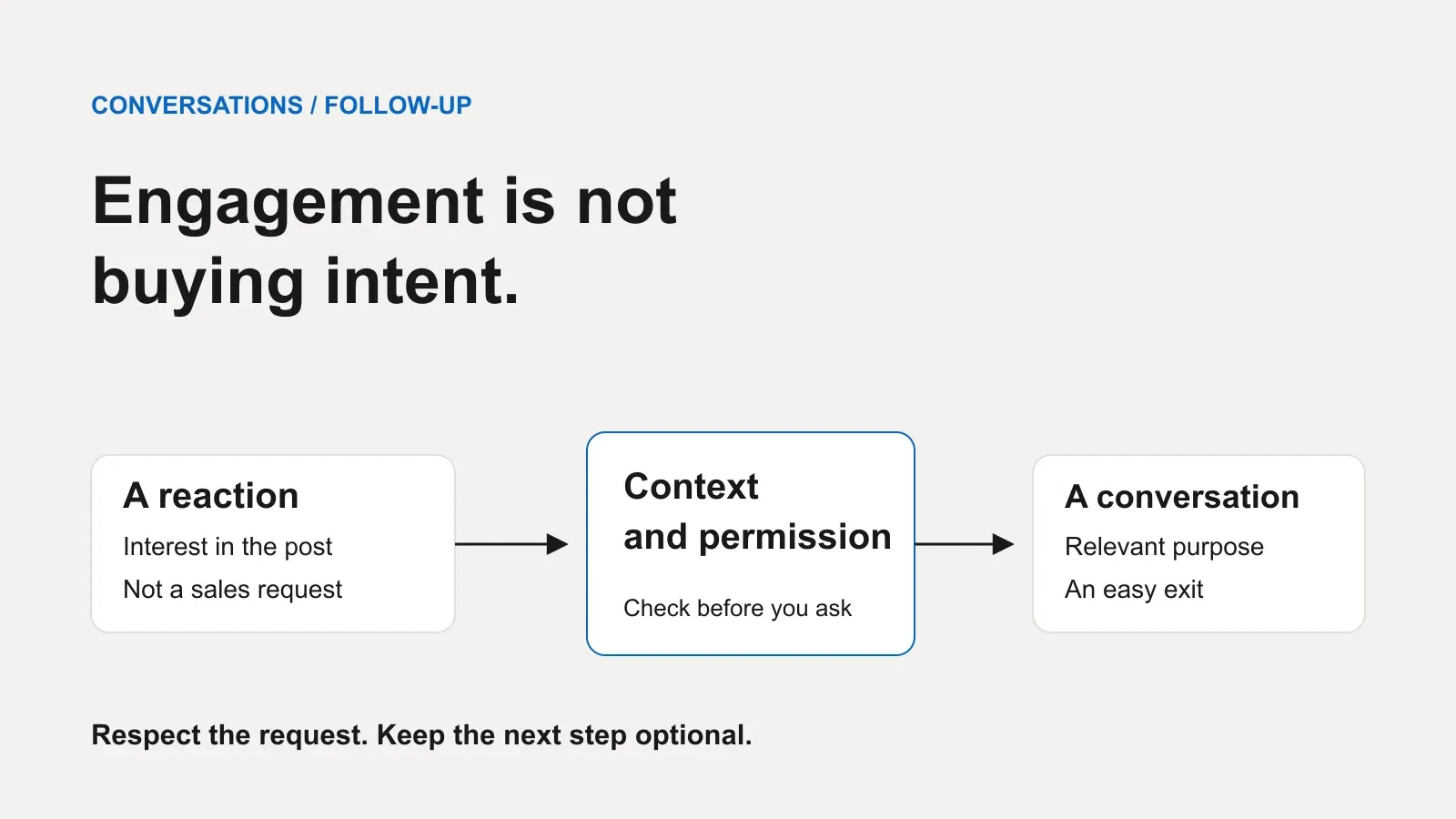
Keep observable engagement separate from inferred need. Someone reacting to a post might appreciate the idea, know the author, or work in an adjacent field. None of those observations establishes a purchasing project.
We recommend a decision path rather than a fixed sequence of messages:
- If the person asks a substantive question, answer it in the context where it was asked.
- If a private follow-up is appropriate, identify the topic and offer a useful next step without pretending interest is already established.
- If the person describes a relevant problem, ask a limited clarifying question before suggesting a meeting.
- If the person declines, asks you to stop, or says the subject is irrelevant, close the follow-up.
An illustrative question is whether the handover problem belongs to their team or somewhere else. The purpose is to understand the situation, not to extract a full buying brief in a direct message.
LinkedIn’s prohibition on irrelevant, obviously unwanted and gratuitously repetitive messages is the policy boundary, not merely a tone preference.[3] Keep the recommendation to be helpful separate from any claim that a particular wording satisfies every platform or legal requirement.
Our engagement-to-conversation framework covers context, permission and an easy exit. At this stage, write down what the person actually expressed rather than describing every reply as intent.
Qualify the next step without overloading the exchangeLink to this section
Before asking for a meeting, check whether the company appears to fit, the issue relates to the product, and the person wants an appropriate next conversation. Leave unanswered questions visible. A missing implementation detail does not need to become an interrogation before a useful introductory call.
Do not impose one definition of qualification on every product. For a technically involved sale, a first call may explore the workflow and identify the reviewer. For a simpler product, the buyer may already have a concrete evaluation question. Write the meeting purpose to match that situation.
In the fictional onboarding example, a person saying they own handovers and want to compare approaches provides a stronger basis for an invitation than a reaction to a post. Budget and purchase timing remain unknown until discussed. This distinction should appear in the handoff note.
Handoff means context, not just a bookingLink to this section
Give the salesperson a concise record: company, role, segment, relevant problem, source of the interaction, expressed interest, unresolved questions and intended meeting purpose. Include what was promised, such as an explanation of a particular workflow or an answer from a technical colleague.
Confirm the receiving owner and scheduling details. If the prospect needs a specialist who will not attend, resolve that mismatch before the call. If the calendar invitation changes, update the record rather than leaving sales with an outdated thread.
Use separate labels for booked, held and sales-qualified. These are proposed reporting definitions to agree with your team, not universal platform stages. A held conversation can appropriately end with no opportunity; record the reason instead of treating the call as a failure to be hidden.
The LinkedIn-to-sales handoff checklist expands the required context and ownership decisions. Require sales feedback to reach the targeting and content owners, not only the person who booked the meeting.
Measure the transitions and keep the cohort visibleLink to this section
Decide what each metric means before reporting it. Our suggested scorecard separates reviewed people, invitations where appropriate, accepted connections, substantive conversations, booked meetings, held meetings, sales-qualified outcomes and opportunities. Content attention belongs alongside that record, not automatically inside the sales funnel.
For each rate, state the numerator, denominator and observation window. A held-meeting rate should say which scheduled meetings were eligible to occur by the cutoff. A conversation rate should explain whether it counts people, threads or messages. Do not divide outcomes from one segment by activity from another.
Record the segment version and route into the conversation. Where content, outreach and an existing relationship overlap, describe the attribution rule and uncertainty. Do not give several activities full credit for the same sale without explaining the model.
Review losses as learning categories: wrong company fit, wrong role, irrelevant problem, scheduling mismatch, no-show or sales disqualification. These are diagnostic hypotheses, not automatic explanations. The metrics scorecard provides the deeper measurement framework.
Platform risk belongs in the operating decisionLink to this section
LinkedIn prohibits third-party software that scrapes or automates activity on its website and says accounts using prohibited tools risk restriction or shutdown.[5] Its User Agreement requires truthful account identity and prohibits sharing or transferring accounts.[6] Review the actual operating method, not just a provider’s description of it.
We are an agency: we run LinkedIn activity for B2B SaaS clients using our own LinkedIn accounts, not the client’s personal account. That describes whose accounts are used; it does not establish platform permission for the method.
As an operational distinction, restriction of an agency-operated account interrupts that account’s work; the client can still face lost conversations, disrupted handoffs and reputation concerns. Using a company’s people’s accounts instead puts those individual accounts directly in the activity path. Account holders remain responsible under LinkedIn’s agreement.[6] Changing whose account is used does not remove the rules.
Read the automation and account-risk guide before choosing a method. Where privacy, representation or contractual responsibilities require legal interpretation, seek qualified advice rather than relying on this editorial framework.
Choose the operating model after defining the workLink to this section
Compare an agency, an in-house sales development representative and a freelancer against the responsibilities above. Ask who researches the ICP, verifies claims, handles replies, maintains handoff records and receives sales feedback. Unassigned work remains your team’s responsibility even when a proposal looks comprehensive.
Our agency versus in-house versus freelancer comparison separates those trade-offs. The agency-selection guide helps examine evidence, reporting and platform-risk transparency.
If you would like to discuss whether this workflow fits your SaaS product and sales capacity, book a call with us. Bring your current segment, the buyer problem and the handoff questions you want to resolve.