LinkedIn Outreach vs Cold Email for B2B SaaS: How to Choose
Choose a channel by buyer access, usable context, operating workload and measurement. A decision matrix explains the platform, sender and legal constraints on both sides.

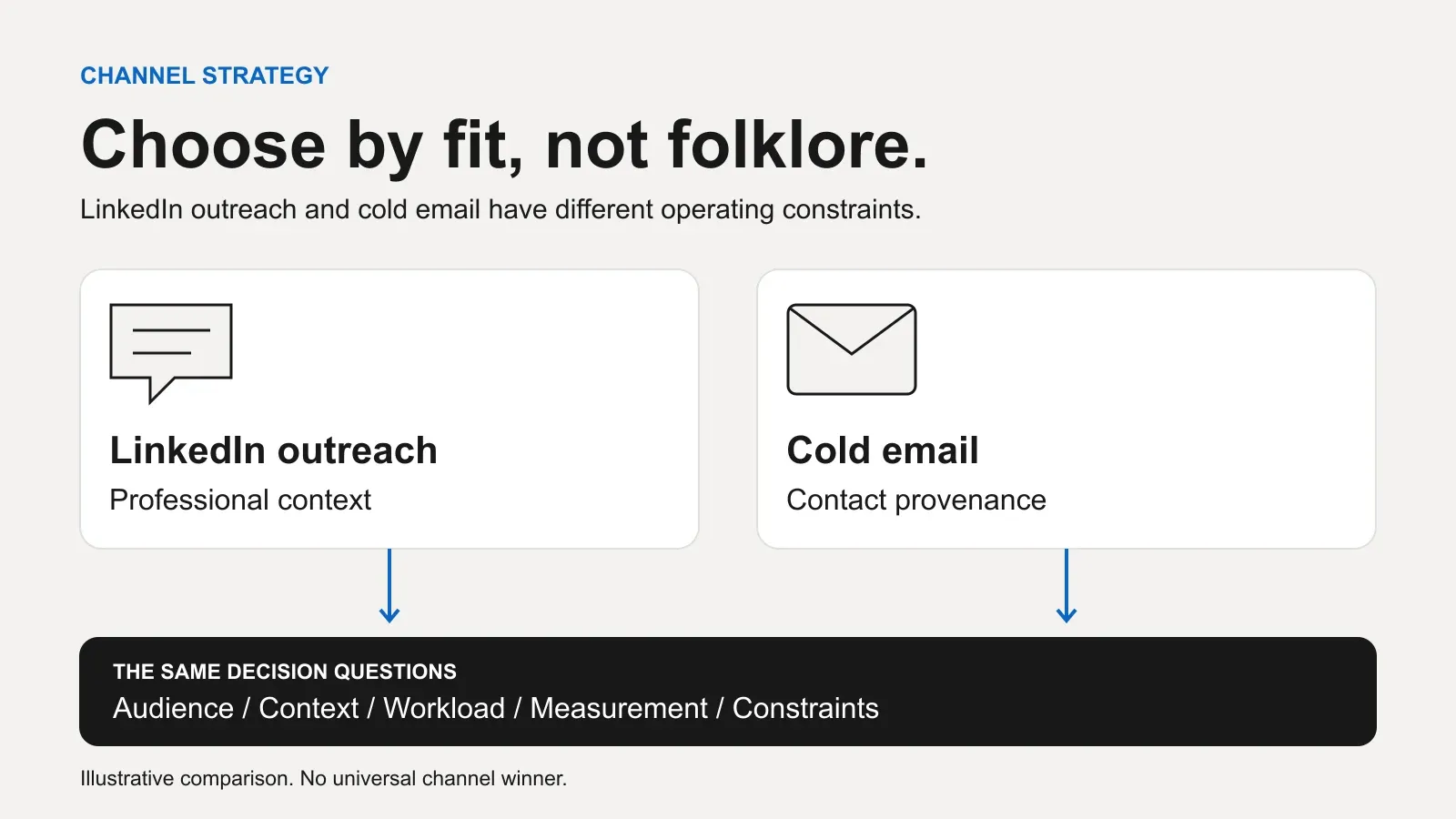
LinkedIn outreach vs cold email is a choice about buyer access and operational fit, not a contest with a universal winner. We would start where your team can identify relevant buyers, explain why the conversation matters and handle replies responsibly.
LinkedIn may fit a segment where you can observe useful professional context. Email may fit a segment where you have a justified contact source and the ability to operate the sending infrastructure. Neither a visible profile nor a known email address settles permission, interest or buying intent.
This guide compares proposed workflows, not platform conversion rates. Policy and regulator guidance was checked on October 8, 2026. The legal section is an orientation, not jurisdiction-specific advice.
Compare audience access before message formatsLink to this section
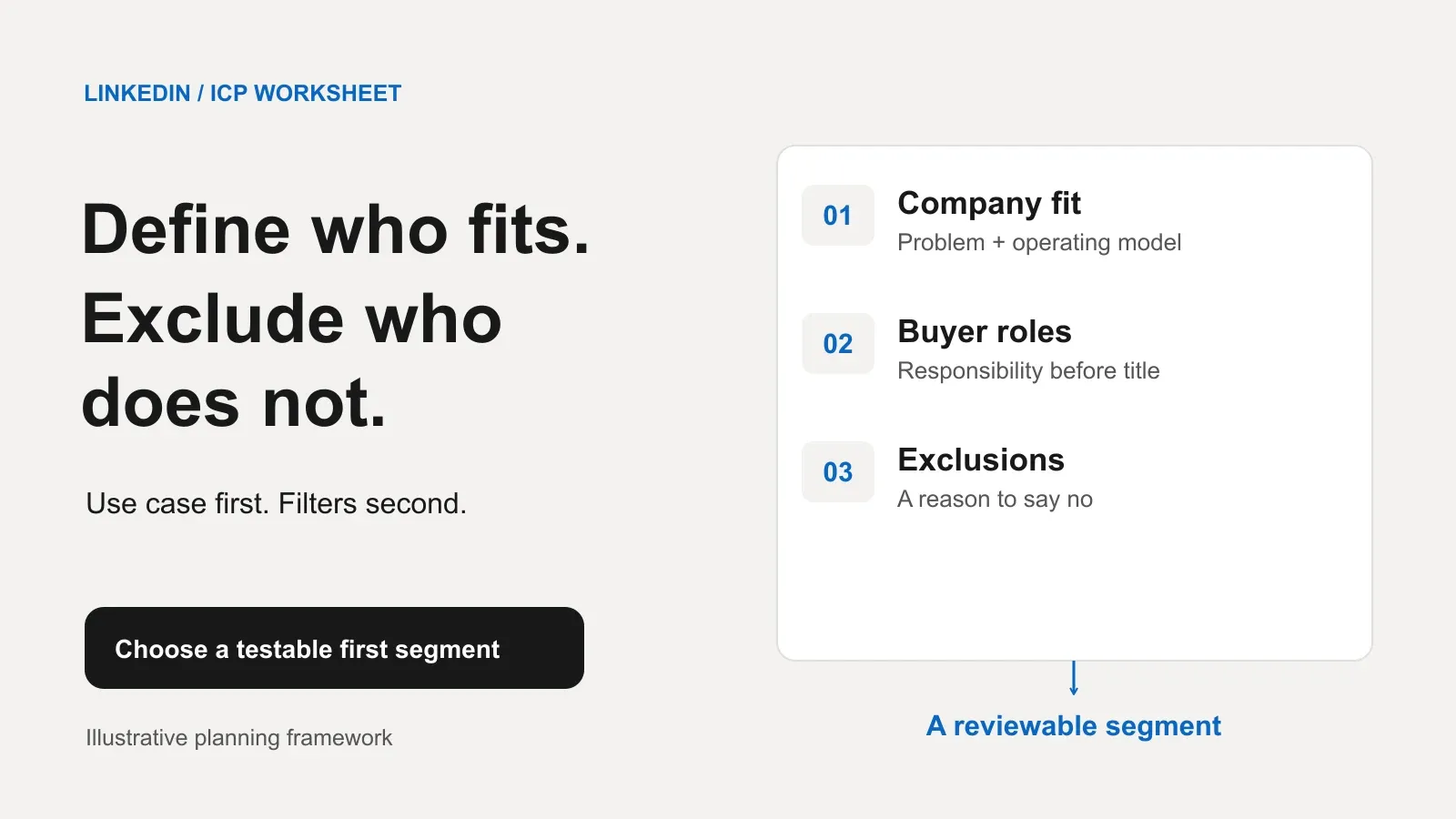
Start with a defined ideal customer profile: company characteristics, buyer role, geography, use case and exclusions. Then investigate whether the people in that segment are realistically reachable through either channel.
For LinkedIn, inspect whether you can identify relevant people and find context that helps you understand their role. Treat a quiet or incomplete profile as an information gap, not proof that the person never buys software. For email, inspect where the address came from, whether it still matches the buyer and what grounds permit its use.
Do not assume the audiences are interchangeable. A person you can identify on LinkedIn may not have an appropriate email contact route. A documented business contact may have little useful activity on LinkedIn. Your initial research should reveal those gaps rather than bury them under a larger list.
We recommend keeping a short access log for each candidate: role evidence, channel evidence, contact provenance and unresolved questions. This is a proposed planning method, not a reason to scrape profiles or collect unnecessary personal details.
Context helps only when it is relevantLink to this section
LinkedIn’s agreement describes profiles, posts, comments and messages as parts of its service.[2] Those surfaces can supply context for a conversation, but the interpretation is yours. Someone discussing a hiring problem has not necessarily expressed interest in your recruitment software.
For email, build the same relevance test without relying on a social interaction: what business problem might this role own, what evidence supports that interpretation and why is your message useful now?
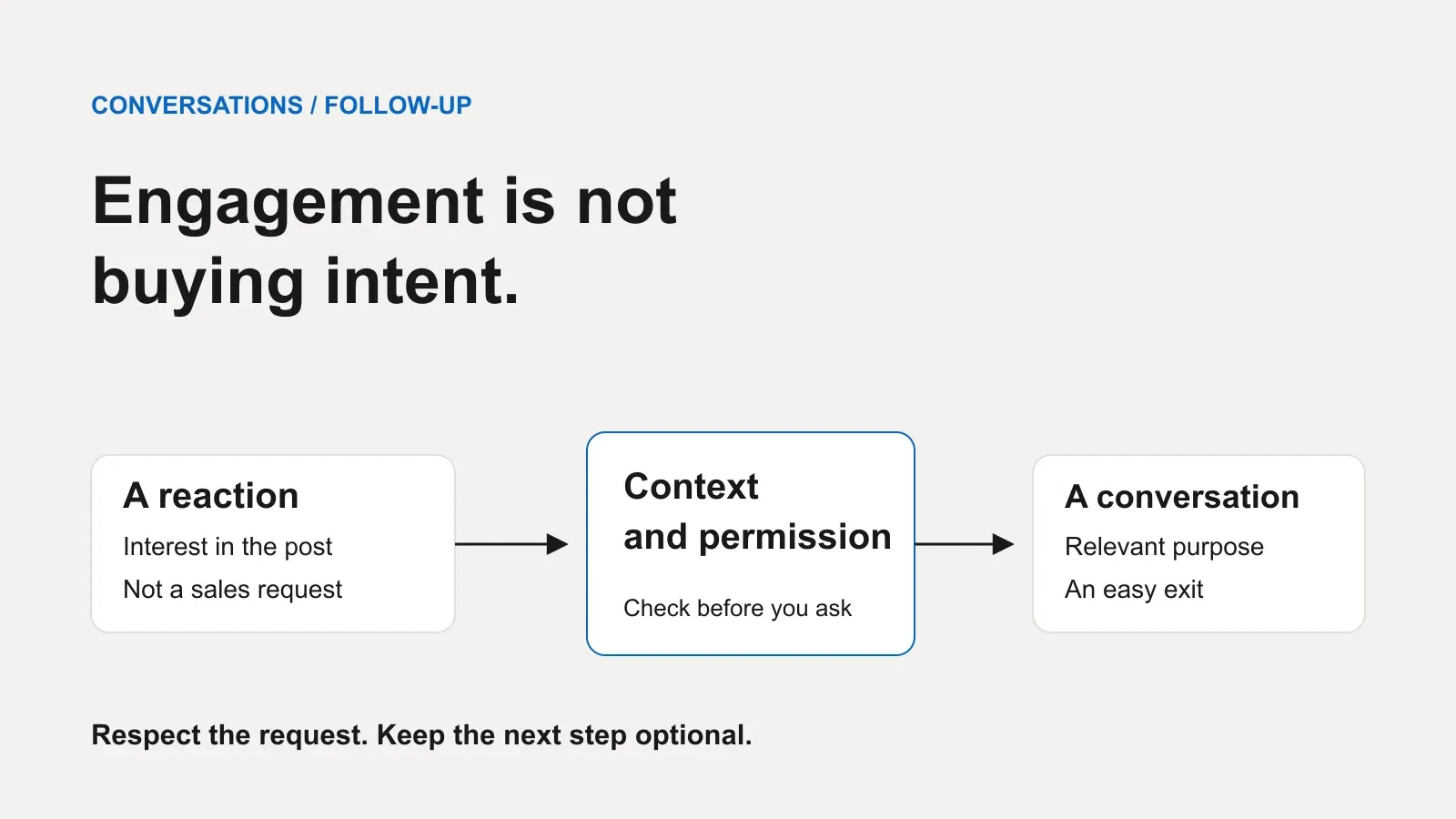
An illustrative opener might say, “Your team describes a move toward self-service onboarding. Is reducing manual account setup part of that work?” That is a fictional wording example, not a real conversation or evidence of performance. Use it only if the underlying statement is true and the contact is appropriate.
Avoid manufacturing familiarity on either channel. A precise, modest reason for contacting someone is more useful than an invented shared interest. If the evidence is weak, improve the targeting or stop rather than adding personalised-looking details.
A decision matrix, not a score declaring a winnerLink to this section
The following matrix is illustrative editorial judgement. Use evidence from your segment to fill it in; the cells are not measured channel advantages.
| Decision question | Investigate LinkedIn when… | Investigate email when… |
|---|---|---|
| Can we identify the intended buyer? | Professional profiles provide useful role evidence | A documented contact source identifies the relevant business recipient |
| Can we explain why we are contacting them? | Public professional context supports a specific conversation | Business evidence supports relevance without invented familiarity |
| Can we do the operating work? | A delivery owner can research, write, handle replies and respect platform rules | An owner can manage authentication, contact quality, opt-outs and replies |
| Can we review constraints? | Identity, access, invitation and messaging practices can be scrutinised | Recipient-country rules and mailbox-provider requirements can be checked |
| Can sales act on interest? | The sales owner can receive context and take suitable meetings | The sales owner can receive context and take suitable meetings |
| What should make us pause? | Weak relevance, complaints, account warnings or unclear access | Unclear contact provenance, objections, delivery failures or excessive complaints |
If neither column has a credible answer, the next task is readiness, not choosing a bigger sending programme. For the LinkedIn workflow, see our B2B SaaS lead-generation guide.
Workload moves rather than disappearsLink to this section
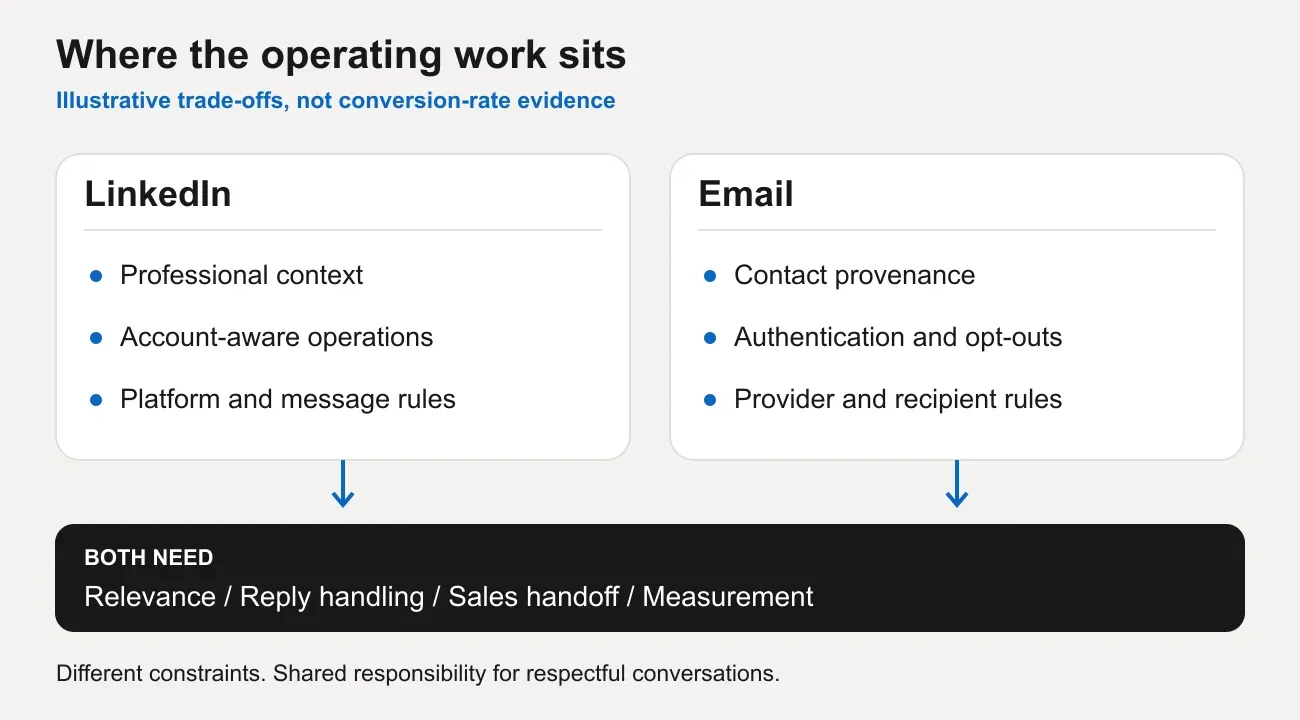
For a proposed LinkedIn programme, assign research, writing, publishing if included, conversation handling and account-policy review. Decide who notices a restriction and who informs sales that a conversation may be interrupted.
For a proposed email programme, assign address provenance review, authentication setup, bounce and complaint monitoring, unsubscribe handling, reply classification and sales handoff. Ask who can fix a technical sending problem; do not place that responsibility on a copywriter by default.
Compare costs over the same scope. Include delivery work, tools, content inputs, retained management time and the sales team’s response capacity. Do not compare an outreach-only email fee with a LinkedIn programme that also includes content and then attribute the difference to the channel.
Using both channels introduces coordination work. We recommend a shared record of conversations and objections so separate operators do not pursue the same person blindly. Do not respond to an objection by simply moving the same unwanted pitch to the other channel.
LinkedIn has platform constraints, not a sending allowanceLink to this section
LinkedIn prohibits third-party software that scrapes or automates activity on its website and warns of account restriction or closure.[1] Its agreement prohibits personal-account sharing and allows limits on connections and contact with other members.[2]
Its community policies prohibit irrelevant, obviously unwanted and repetitious messaging. They also prohibit using invitations to send promotional messages to people you do not know.[3] A manual workflow still needs to respect those rules; agency involvement does not settle the question.
There is no daily activity number in this guide that makes prohibited conduct acceptable. For a fuller review, read our automation and account-risk guide.
As a dependency distinction, activity through an agency’s own accounts exposes those holders directly to account action, while the client still depends on conversation continuity. Through a startup’s people’s accounts, those people face the direct account exposure. Neither arrangement removes business or reputational concerns.
Email has sender requirements beyond writing a good messageLink to this section
Authentication acronyms matter here: SPF identifies authorised sending servers, DKIM signs messages, and DMARC checks alignment with the visible sender domain and publishes a handling policy. Google’s guidance explains these mechanisms.[4] Ask your email operator to verify them, not merely tick a proposal checkbox.
Google: distinguish personal Gmail from Workspace recipientsLink to this section
Google’s guidance covers mail to personal Gmail accounts, not inbound Google Workspace mail. Its FAQ defines bulk senders as those sending close to 5,000 or more messages in a 24-hour period to personal Gmail accounts, counting the same primary domain together. Once classified, bulk-sender status is permanent.[5]
The bulk requirements include SPF and DKIM, DMARC with at least a p=none policy, From-domain alignment, valid forward and reverse DNS, TLS transport and properly formatted messages. Marketing and subscribed messages need one-click unsubscribe plus a visible body link. Google’s guidelines require reported spam rates below 0.3%.[4] Its FAQ recommends staying below 0.1%, avoiding 0.3% or higher, and fulfilling unsubscribe requests within 48 hours. A body link alone does not meet Google’s one-click requirement, which uses RFC 8058 List-Unsubscribe headers.[5]
Google also advises against sending to people who did not sign up for your messages. These are provider definitions and thresholds, not outreach targets or permission to send unsolicited messages. Google also has requirements for non-bulk senders, so being below the bulk threshold does not remove sender obligations.[4]
Yahoo: do not import Google’s volume thresholdLink to this section
Yahoo’s bulk requirements include SPF and DKIM, DMARC with at least p=none, From-domain alignment, functioning list-unsubscribe support for marketing and subscribed messages, a visible body unsubscribe link and processing opt-outs within two days. It also requires valid forward and reverse DNS and standard message formatting. It requires spam complaints below 0.3%, calculated against mail delivered to the inbox.[6]
Yahoo does not publish a numerical bulk-volume threshold. Its FAQ applies the requirements to Yahoo-hosted consumer domains, including AOL, but not the separate Yahoo Japan service.[7] Yahoo’s recommendations favour requested mail and advise against purchased mailing lists.[6] Technical authentication does not establish recipient consent or inbox placement.
Legal basics: U.S. rules are not an EU permission slipLink to this section
U.S. commercial email and CAN-SPAMLink to this section
The FTC says CAN-SPAM covers commercial email, not just bulk campaigns, and makes no exception for B2B email. Its guide calls for accurate sender information and subject lines, identifying advertisements, a valid physical postal address and a clear opt-out mechanism. Opt-outs must be honoured within 10 business days, and the mechanism must operate for at least 30 days after sending.[8]
Hiring a sender does not remove the promoting company’s legal responsibility; both parties may be responsible under the FTC’s guidance.[8] Provider expectations can be stricter than that statutory opt-out deadline. Meeting CAN-SPAM requirements is not evidence that a mailbox provider wants the message or that another country’s rules permit it.
EU personal data and electronic marketingLink to this section
Under the General Data Protection Regulation (GDPR), the European Commission explains that processing personal data needs a legal ground; legitimate interests require assessing individuals’ rights, not simply asserting a business benefit. It also requires checking contact-list provenance, respecting direct-marketing objections and informing people about processing. Email marketing additionally falls under ePrivacy rules.[9] A GDPR ground alone does not settle permission to send.
National rules and recipient context matter. As a France-specific example, CNIL’s guidance dated June 10, 2026 generally requires prior consent for consumer outreach, with limited exceptions, and distinguishes professional outreach that may rely on legitimate interests when related to the recipient’s profession. Professional recipients must be informed and able to object simply and freely; each solicitation must identify the organisation and allow refusal.[10] Do not extrapolate that example into blanket permission across the EU.
Measure a pilot without inventing a benchmarkLink to this section
We do not present a sourced, methodologically matched head-to-head benchmark here. LinkedIn invitation acceptance and email opens are not comparable outcomes. Even reply rates need the same audience, contact stage, time window and definition before a comparison is meaningful.
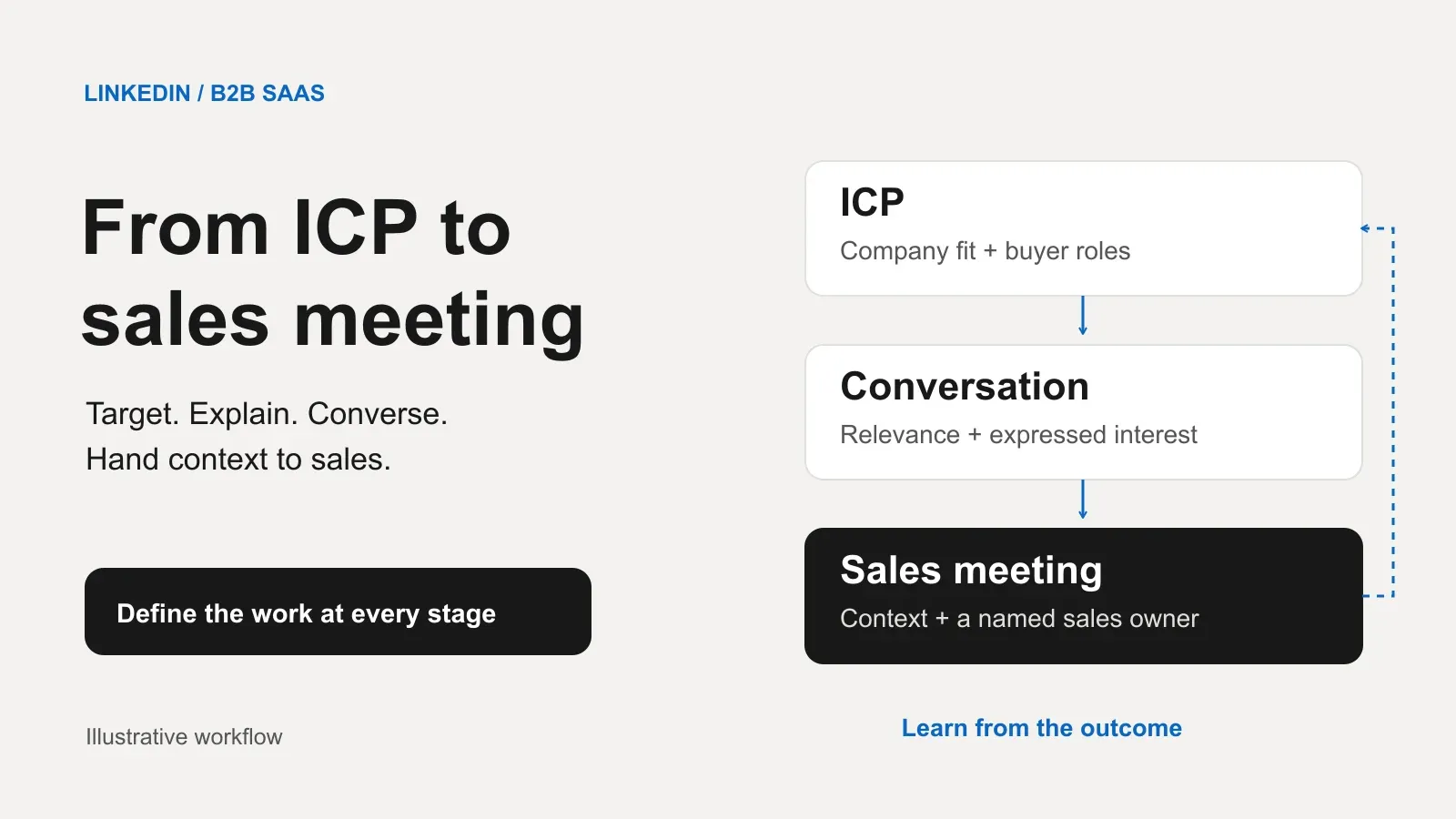
Define the unit before starting: people or accounts approached, relevant replies, qualified conversations, meetings held and sales-accepted opportunities. Record which channel initiated the conversation and whether another touch contributed. Use the metrics scorecard to keep stage definitions consistent.
An illustrative pilot should use comparable buyer segments and observation windows, record channel access failures separately, and include staff time. Review unwanted contact, objections, delivery failures and account warnings alongside commercial interest. If buyers receive both channels, call it a combined workflow rather than assigning all credit to whichever touch came last.
Choose the channel whose access, constraints and operating work your team can support, then let observed learning inform the next decision. If you want to explore the LinkedIn side of that choice, you can book a call with us.
Sources
- Prohibited software and extensions
- User Agreement
- Professional Community Policies
- Email sender guidelines
- Email sender guidelines FAQ
- Sender Requirements & Recommendations
- FAQs, Email Sender Requirements
- CAN-SPAM Act: A Compliance Guide for Business
- Legal grounds for processing data
- La prospection commerciale par courrier électronique, SMS-MMS et automate d’appel